How to Replace Your Old AC With a New System in Scottsdale, AZ
Champion Air
Learn how your old ac is removed and new system installed in Scottsdale with Champion Air Conditioning & Heating for reliable comfort.
How to Replace Your Old AC With a New System in Scottsdale, AZ
What Really Happens When Your Old AC Is Removed and a New System Is Installed
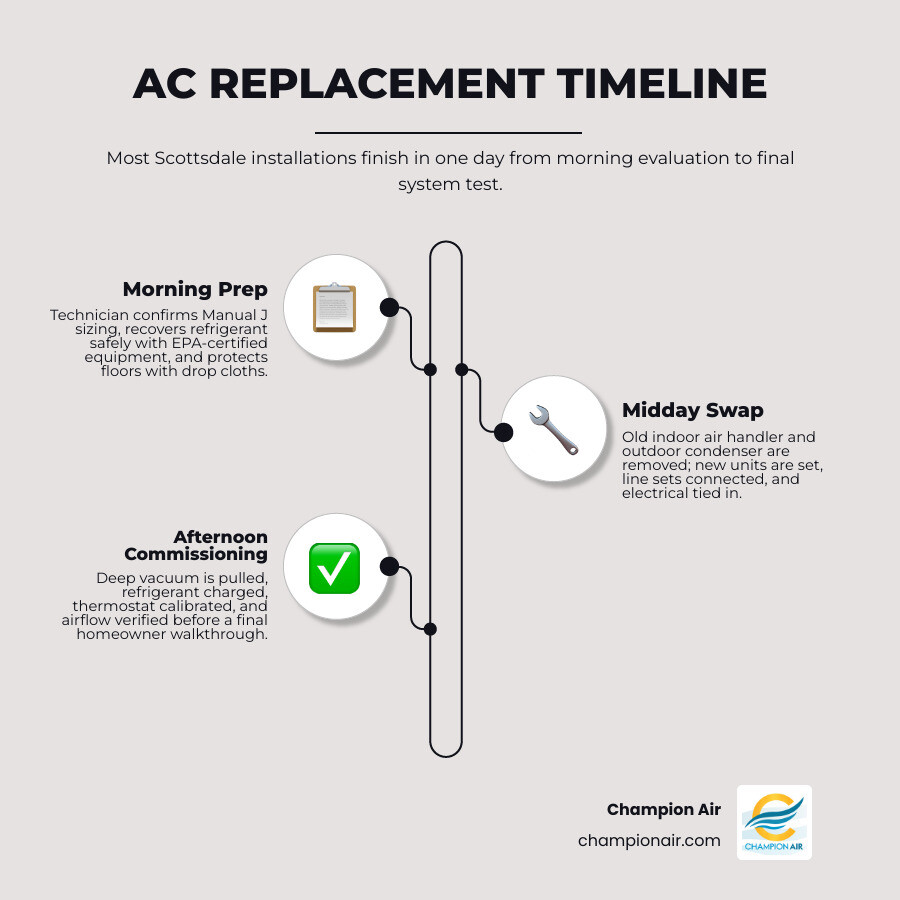
Understanding how your old AC is removed and new system installed can make the whole experience far less stressful — especially when Arizona summer heat leaves no room for delay. Here is a quick overview of the full process:
- In-home evaluation — A technician assesses your home's size, insulation, windows, and ductwork to size the new system correctly.
- Refrigerant recovery — The old system's refrigerant is safely extracted using EPA-certified equipment before anything is disconnected.
- Old unit removal — The indoor air handler and outdoor condenser are disconnected, removed, and staged for disposal.
- Site preparation — Drop cloths protect your floors and walls while the work area is cleared for the new equipment.
- New system installation — The new indoor and outdoor units are set in place, with refrigerant lines, electrical connections, and condensate drainage all connected to spec.
- System commissioning — Technicians pull a deep vacuum on the lines, charge the refrigerant, calibrate the thermostat, and verify airflow throughout your home.
- Final walkthrough — You get a full explanation of how your new system works before the team leaves.
Most standard AC replacements in Scottsdale are completed in a single day — typically between 7 and 14 hours depending on the complexity of your setup.
For the average Arizona homeowner, a failing or aging AC is not just an inconvenience — it is a genuine safety concern. With 88% of U.S. homes relying on air conditioning and Scottsdale summers pushing well past 110°F, a system that is struggling, breaking down repeatedly, or simply past its useful life of 10 to 15 years puts your family's comfort and health at risk. The good news is that when the process is done right, a full AC replacement is a straightforward, single-day project that leaves you with a cooler, more efficient home.
I'm Barry Farah, and as the leader of one of Arizona's largest Lennox family-owned residential HVAC replacement companies, I have guided thousands of Scottsdale homeowners through exactly how your old AC is removed and new system installed — from the first evaluation to the final walkthrough. Let me walk you through every step of the process so you know exactly what to expect.
Precision Sizing: The Manual J Load Calculation
Before a single wrench is turned, the most critical step of your installation happens: the load calculation. Many people assume they should just buy the same size unit they currently have. However, if your original unit was sized incorrectly, or if you’ve added new windows or insulation in the last decade, you could end up with a system that is either too weak for a Phoenix July or so oversized that it "short-cycles," wearing out the compressor prematurely.

At Champion Air, we use the Manual J Load Calculation. This isn't a "rule of thumb" based on square footage alone. We look at:
- Square footage and ceiling height: More volume means more air to cool.
- Insulation levels: We check the R-value in your attic and walls.
- Window orientation and sun exposure: In Scottsdale, west-facing windows are heat magnets.
- Ductwork condition: We ensure your existing vents can handle the airflow of a modern high-efficiency system.
Proper sizing is the only way to ensure your new investment operates at peak performance. If you are still on the fence about whether to pull the trigger, our guide on How to Decide Between AC Repair and Replacement can help you weigh the long-term benefits of a new system against the mounting costs of fixing an old one. Upgrading to a modern SEER2-rated system can often cut your cooling energy use by 20% to 50%, which is a significant saving considering AC accounts for nearly 19% of all residential electricity use nationwide. For a deeper dive into the financial side, check out our breakdown of Air Conditioner Replacement Cost.
How Your Old AC is Removed and New System Installed: The Complete Guide
Once you’ve selected your new equipment, installation day arrives. It’s a coordinated dance of logistics and technical skill. Our team arrives with the goal of being as non-intrusive as possible.
The process begins with site protection. We treat your home like our own, laying down drop cloths and floor runners from the entry point to the attic or mechanical closet. We clear a workspace around both the indoor air handler and the outdoor condenser to ensure safety and efficiency. This is also when we perform a final infrastructure evaluation, double-checking that the existing electrical and ductwork are ready for the upgrade. This level of care is a hallmark of our AC Installation & Replacement service.
Preparing the Site: How Your Old AC is Removed and New System Installed Safely
The removal of the old unit isn't just about hauling away heavy metal; it’s about environmental safety. The most crucial part of this stage is refrigerant recovery. It is illegal and harmful to vent old refrigerant into the atmosphere. Our technicians use specialized recovery machines and tanks to extract every ounce of refrigerant according to EPA 608 certification requirements.
If you’ve been wondering When to Repair vs Replace Your AC System, the age and type of refrigerant in your old unit are often deciding factors. Older R-22 systems are increasingly expensive to maintain because the refrigerant is no longer being produced.
After the refrigerant is gone, we:
- Disconnect the electrical: We shut off power at the breaker and disconnect the high-voltage and low-voltage wiring.
- Sever the line sets: The copper lines connecting the indoor and outdoor units are cut and capped.
- Remove the equipment: We use hand trucks and dollies to safely move the old condenser and air handler out of your home.
- Clean the area: We remove any debris, old mounting hardware, or dust that accumulated over the last 15 years.
Final Connections: How Your Old AC is Removed and New System Installed for Longevity
Now, the new system begins to take shape. We start by installing the new indoor evaporator coil and air handler. This is a precision job; the unit must be perfectly level to ensure proper condensate drainage. If it’s tilted, water can pool and lead to mold or water damage—a lesson many homeowners learn the hard way with poor installations.
Outside, we prepare the area for the new condenser. We often install a new, level pad or ensure the existing one is stable. We use vibration pads under the unit to reduce noise and prevent the system from shaking itself loose over time. Understanding How Proper AC Installation Affects Long-Term Performance is key here; a unit that isn't level or securely mounted will experience significantly more wear and tear on the compressor.
Next, we run new copper line sets or thoroughly flush the existing ones to ensure no old oil or contaminants remain. These lines are then brazed (a high-temperature welding process) to create a leak-proof seal.
Technical Integration: Electrical and Ductwork Connections
With the heavy equipment in place, it’s time for the "nervous system" of your AC to be connected. Modern high-efficiency systems often have different electrical requirements than units built in the early 2000s.
| Feature | Old System (10-15+ years) | New High-Efficiency System |
|---|---|---|
| Efficiency Rating | 8 - 10 SEER | 14 - 25+ SEER2 |
| Refrigerant | R-22 (Phased out) | R-410A or R-454B (Eco-friendly) |
| Thermostat | Basic Programmable | Smart/Communicating |
| Blower Motor | Single Speed (On/Off) | Variable Speed (Precision) |
| Noise Level | High (75+ decibels) | Low (as quiet as 50 decibels) |
We inspect your circuit breakers to ensure they match the manufacturer’s specifications for the new unit. If the wiring is frayed or undersized, we replace it to prevent fire hazards. We also connect the thermostat wiring—often upgrading you to a smart thermostat that can be controlled from your phone.
Ductwork is the most overlooked part of how your old AC is removed and new system installed. We check for "static pressure"—the resistance the air faces as it moves through your home. If your ducts are leaky or undersized, your brand-new AC will struggle to push air, leading to hot spots and high bills. We seal connections with professional-grade mastic to ensure every bit of cooled air reaches your living room. If you ever notice uneven cooling after an install, it’s often a ductwork issue that requires our AC Repair Service experts to diagnose.
System Commissioning: Testing and Quality Assurance
The units are in, the wires are connected, but we don't just "flip the switch." The commissioning phase is what separates a professional installation from a DIY-style job.
First, we perform a nitrogen pressure test to ensure there are no leaks in our brazed joints. Once we know the system is airtight, we use a vacuum pump and a micron gauge to pull a "deep vacuum." This removes all air and moisture from the refrigerant lines. Even a tiny drop of moisture inside a refrigerant line can turn into acid over time, eating your compressor from the inside out.
Once the vacuum is held, we "charge" the system with the precise amount of refrigerant specified by the manufacturer, weighed in on a digital scale. We then start the system and perform a series of checks:
- Airflow optimization: We adjust the blower speed to match your home’s specific ductwork.
- Temperature split: We measure the air going in versus the air coming out to ensure a 16-20 degree drop.
- Thermostat calibration: We verify that the temperature on the wall matches the actual temperature in the room.
This rigorous testing is essentially a built-in AC Maintenance Tune-Up to ensure your system starts its life in perfect condition.
Homeowner Preparation: Getting Ready for Installation Day
To help us get your home back to a comfortable temperature as quickly as possible, there are a few things you can do to prepare:
- Clear the path: Ensure our technicians have a clear, 3-foot wide path to the indoor unit (attic, closet, or garage) and the outdoor unit.
- Secure your pets: The noise of vacuum pumps and drills can be stressful for dogs and cats, and we’ll be moving in and out of the house frequently.
- Trim vegetation: If you have bushes or cacti growing near your outdoor condenser, trimming them back at least 2 feet will provide the airflow the new unit needs.
- Attic clearance: If your unit is in the attic, please move any holiday decorations or storage bins that might be blocking the access hatch.
Once the installation is complete, we perform a final walkthrough. We’ll show you how to program your new thermostat, how to change your filters (which you should do every 1-3 months!), and explain the warranty paperwork. We don't consider the job done until you are comfortable and all your questions are answered.
Frequently Asked Questions about AC Replacement
How long does a typical AC removal and replacement take?
For most homes in Scottsdale, Phoenix, or Mesa, a standard AC replacement takes between 8 and 14 hours. If we are only replacing the outdoor condenser and the indoor coil (a "split system"), it may take closer to 4-8 hours. However, if we are modifying ductwork, upgrading an electrical panel, or installing a full HVAC system (including a furnace), it can take a full day or occasionally stretch into a second day.
Do I need to leave my home during the installation?
No, it is perfectly safe to stay home! However, keep in mind that the power will be off for several hours, meaning no lights, Wi-Fi, or—most importantly—cooling. There will also be some noise from power tools and the sound of technicians communicating. Most homeowners choose to stay in a room away from the workspace or run errands during the middle of the day.
Will a new thermostat be included with my system?
In most cases, yes. Modern high-efficiency systems often require a specific smart thermostat to communicate with the variable-speed motors and sensors inside the unit. These thermostats are much more than just a digital display; they help optimize energy savings and allow you to monitor your system’s health from your smartphone.
Conclusion
Replacing your air conditioner is a significant investment, but in the Arizona desert, it is an investment in your family's quality of life. By understanding how your old AC is removed and new system installed, you can move forward with confidence, knowing that a professional team is handling the heavy lifting, the technical wiring, and the environmental safeguards.
At Champion Air, we are proud to serve Scottsdale, Phoenix, Mesa, and the surrounding Valley cities with award-winning service. We specialize in making installation day as smooth and stress-free as possible, ensuring your new system provides reliable, efficient comfort for the next 15 years.
Don't wait for your old unit to leave you stranded in the heat. Schedule your professional AC installation and replacement in Phoenix and Scottsdale today and experience the peace of mind that comes with a Champion-grade installation.
About the Author
Champion Air
More Articles
View All PostsKeep Reading
Related Articles


Ready to Get Started?
Whether you need a repair, maintenance, or a new installation, our expert team is here to help.