How to decide between AC repair and replacement without losing your cool
Champion Air
Learn how to decide between AC repair and replacement using the $5,000 Rule, Arizona climate factors & efficiency incentives. Save money now!
How to decide between AC repair and replacement without losing your cool
Why Knowing How to Decide Between AC Repair and Replacement Can Save You Thousands in Arizona
How to decide between AC repair and replacement comes down to five key factors:
- System age - Units over 10 years old in Arizona are entering late-life territory
- The $5,000 Rule - Multiply your unit's age by the repair cost; if the result exceeds $5,000, replacement is usually the smarter move
- The 50% Rule - If a single repair costs more than half the price of a new system, replace it
- Refrigerant type - Systems running on R-22 (Freon) are costly to service due to the 2020 production ban
- Repair history - Two or more major repairs in a single season is a strong signal to replace
If your Arizona summer just got a lot hotter because your AC quit, you already know that this isn't a decision you can sit on. A broken air conditioner in Phoenix or Scottsdale isn't just an inconvenience — it's a genuine safety concern. The pressure to make a fast call, often with a technician standing in your living room, is real. And that pressure is exactly where expensive mistakes happen.
Most homeowners either spend too much keeping a dying system alive, or they replace a unit that had years of reliable service left or. Neither outcome is good. The good news is there's a clear, numbers-based way to cut through the noise and make a confident decision — one that protects your budget and your family's comfort.
I'm Barry Farah, and alongside my son I lead Champion Air, the largest Lennox family-owned residential HVAC replacement company in Arizona — a position that has given me a front-row seat to every scenario imaginable when it comes to how to decide between AC repair and replacement. In the sections below, I'll walk you through the exact framework we use to help Arizona homeowners make this call with confidence, not guesswork.
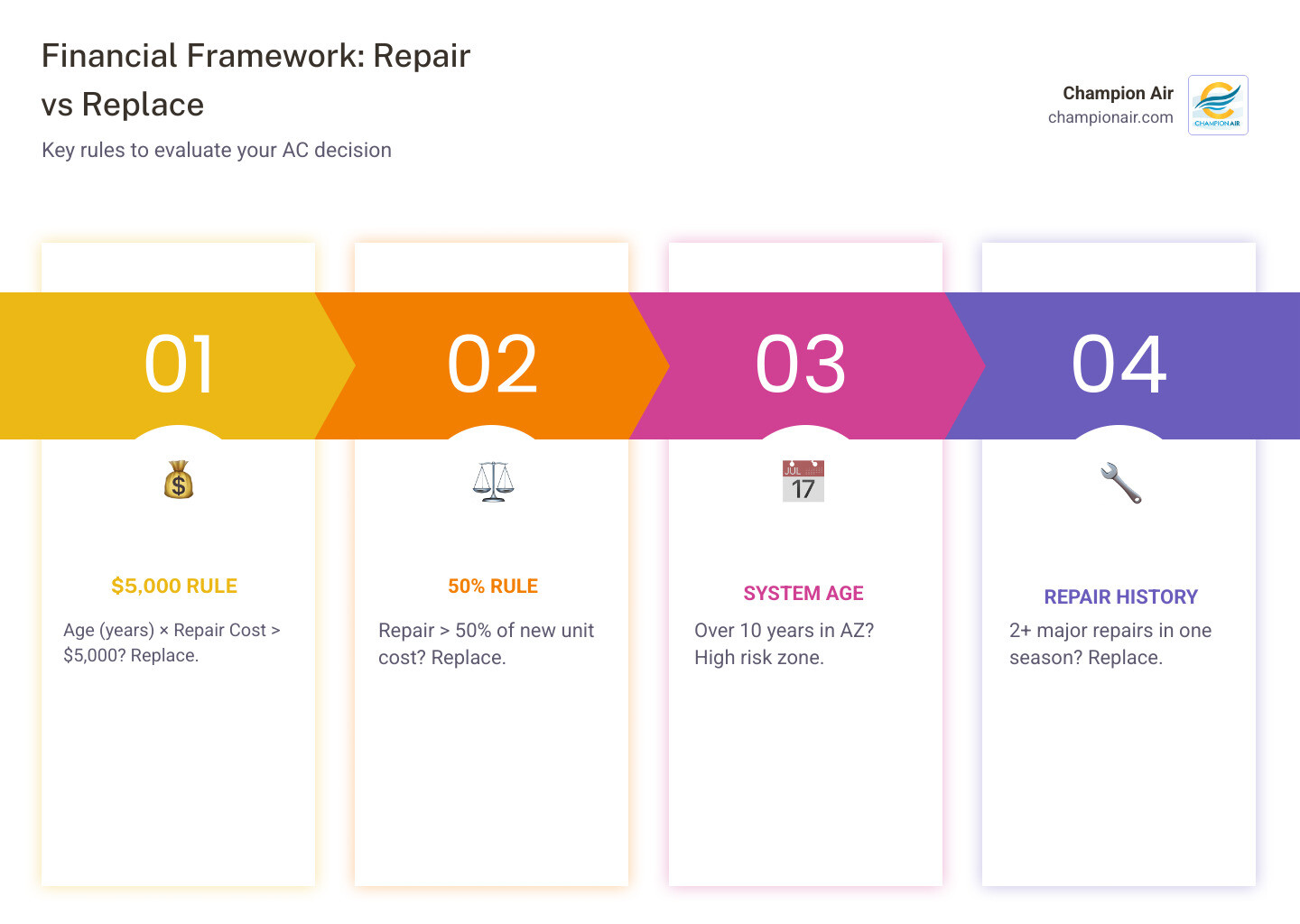
The Financial Framework: How to decide between AC repair and replacement
When we are faced with a major mechanical failure, it is easy to let emotion or immediate stress drive the car. However, we always recommend looking at the data. Making a choice based on a solid financial framework ensures you aren't "throwing good money after bad."
| Criteria | Lean Toward Repair | Lean Toward Replacement |
|---|---|---|
| System Age | Under 8 Years | Over 12 Years (8-12 is the "Decision Zone") |
| Repair Cost | Minor (Capacitors, fan motors) | Major (Compressor, evaporator coil) |
| Refrigerant | R-410A or newer | R-22 (Freon) |
| Reliability | First breakdown in years | Multiple failures this season |
| Efficiency | Satisfied with energy bills | Bills rising despite maintenance |
The 50% Rule is a classic industry benchmark: if the quote for a single repair is more than 50% of the Air Conditioner Replacement Cost, it is almost always better to invest that money into a new system. In the Phoenix Valley, where systems work three to four times harder than the national average, the AC Repair Cost in Phoenix can scale quickly, making this rule particularly relevant for our local neighbors in cities like Mesa, Chandler, and Gilbert.
Applying the $5,000 Rule to how to decide between ac repair and replacement
One of the most objective tools in our kit is the $5,000 Rule. To use it, simply multiply the age of your unit by the estimated repair cost. If the total is less than $5,000, repair it. If it exceeds $5,000, it’s time to look at new units.
For example, if you have a 10-year-old unit in Peoria and it needs a $600 repair, the math is 10 x 600 = 6,000. Since 6,000 is greater than 5,000, the financial viability of that repair is low. You’re likely better off putting that $600 toward a down payment on a new, high-efficiency system. Conversely, a 5-year-old unit needing the same $600 repair (5 x 600 = 3,000) is a clear candidate for AC Repair Services.
Refrigerant obsolescence and how to decide between ac repair and replacement
In May 2026, we are operating in a landscape where refrigerant types heavily dictate serviceability. If your system was installed before 2010, it likely uses R-22 (Freon). Because the EPA banned the production and import of R-22 in 2020, the remaining supply is extremely scarce. This has led to "scarcity surcharges" that can make a simple recharge cost between $400 and $1,500+ per pound.
Even R-410A, which replaced Freon, is now being phased down in favor of newer, more eco-friendly refrigerants like R-454B or R-32. When Comparing System Options, we have to consider that "nursing" an R-22 system is essentially a "bridge strategy" that will eventually fail when parts or refrigerant simply become unavailable or prohibitively expensive.
The Impact of the Arizona Climate on System Lifespan
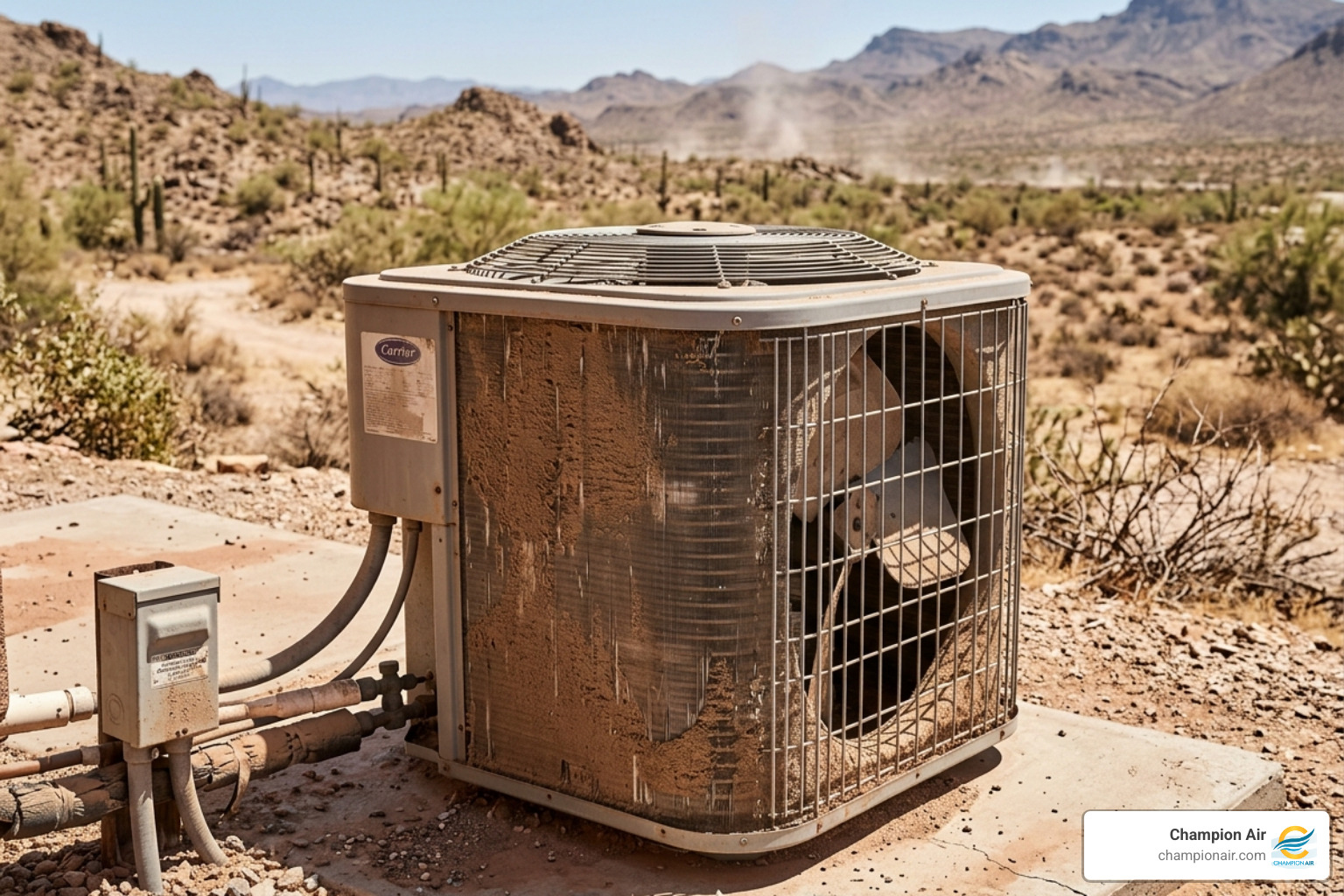
National averages for AC lifespan are often misleading for those of us living in the Phoenix Valley. While the Department of Energy suggests a system might last 15 to 20 years in a temperate climate like the Midwest, the reality here is different. In cities like Scottsdale and Surprise, our systems accumulate 2,000 to 2,700 annual runtime hours.
So, How Long Do Air Conditioners Last in Arizona? Typically, we see an effective lifespan of 8 to 12 years. The extreme thermal stress of 110°F+ days, combined with monsoon dust and intense UV degradation on plastic and rubber components, means a 10-year-old system in Phoenix has essentially "lived" as long as a 30-year-old system in Minnesota.
This "Desert Climate Adjustment" is vital. If your unit is 12 years old and struggling, it isn't just old—it's a veteran of twelve brutal Arizona summers. It has earned its retirement.
Technical Red Flags: When Replacement is the Only Logical Choice
There are certain mechanical failures that serve as a "death knell" for an aging AC unit. When these occur, we often advise against repair because they frequently lead to a failure cascade.
- Compressor Failure: The compressor is the "heart" of your system. If it fails on a unit out of warranty, the AC Compressor Replacement Cost is so high that it rarely makes sense to fix.
- Evaporator Coil Leaks: Corroded coils on an older system often mean the rest of the system is also nearing its end.
- Mismatched Systems: If you replace only the outdoor unit but keep an ancient indoor air handler, you lose efficiency and risk premature failure of the new component.
We look for Indicators It Is Time to Replace Your HVAC System, such as these major component failures. If you notice 5 Signs You Need Service—like strange grinding noises, persistent moisture around the unit, or a complete lack of airflow—don't wait for a total meltdown. Catching these early can help you plan a replacement on your own timeline rather than in a 2:00 AM emergency.
Financial Incentives and Efficiency Gains in 2026
The "silver lining" of how to decide between AC repair and replacement in 2026 is the incredible array of incentives available. Modern systems are now rated under SEER2 standards, which are much more rigorous than the old SEER ratings.
Upgrading from an old 10 SEER unit to a modern 18+ SEER2 system can slash your monthly cooling consumption by 30% to 50%. In a high-heat environment like ours, that can translate to hundreds of dollars in savings every summer.
Furthermore, 2026 federal tax credits (often totaling $2,000 or more) and local utility rebates from providers like SRP and APS can significantly offset the initial investment. Modern Air Conditioning Services also offer variable-speed technology, which allows the unit to run at lower, quieter speeds to maintain a perfectly consistent temperature, rather than the "all or nothing" blast of older models.
Frequently Asked Questions about AC Decisions
Is it better to repair my AC if I plan on selling my home soon?
This is a common dilemma for homeowners in growing areas like Buckeye or Queen Creek. While a new AC can increase property value and serve as a massive buyer incentive, a minor repair might be enough to pass a home inspection. However, if the system is over 12 years old, many buyers will ask for a replacement or a significant credit anyway. Providing a brand-new, warrantied system can often help a home sell faster and for a higher price.
How do I know if my comfort issues are fixable or inherent to an old system?
If you have "hot spots," high humidity, or poor airflow, it could be a simple ductwork leak or a dirty coil. However, if the system is aging, these issues are often inherent. Older systems struggle to remove humidity effectively, which is why your home might feel "clammy" even if the air is cool. A professional load calculation can determine if your current system is simply undersized for your home's needs.
What are the hidden costs of "nursing" an old AC unit?
The most obvious hidden cost is the Efficiency Gap—the money you are overpaying every month to run an inefficient unit. Then there are the emergency service fees. Breaking down on a Saturday in July often means higher diagnostic fees and long wait times. Finally, there is the "Peace of Mind" factor. Knowing your system won't quit during a 115°F heatwave is a value that is hard to put a price on.
Conclusion
At Champion Air, we believe in giving our customers in Scottsdale, Phoenix, and across the Valley the same advice we’d give our own families. Sometimes, a $200 capacitor is all you need to get back to cooling. Other times, the most "pro-homeowner" move we can make is telling you that your system is a "sunk cost" and it’s time to move on.
We specialize in high-efficiency Air Conditioning Services and replacement, providing non-commissioned advice so you never feel pressured. Whether you are in Anthem, Tempe, or Surprise, we are here to help you run the numbers and make the best choice for your home. If you're struggling with how to decide between AC repair and replacement, give us a call—we’ll help you stay cool, no matter what the math says.
About the Author
Champion Air
More Articles
View All PostsKeep Reading
Related Articles


Ready to Get Started?
Whether you need a repair, maintenance, or a new installation, our expert team is here to help.