Why your mild winter climate makes a heat pump a no-brainer
Champion Air
Discover heat pump advantages for mild winter climates: superior efficiency, year-round comfort & savings in Arizona-style weather.
Why your mild winter climate makes a heat pump a no-brainer
Looking to Upgrade Your Home’s Heating in Scottsdale, Phoenix, or Mesa? Why a Heat Pump Makes Sense for Mild Arizona Winters
The heat pump advantages for mild winter climates are hard to ignore — especially here in Arizona, where winters are short, temperatures rarely dip below freezing, and a single system needs to handle both a cool January morning and a blazing July afternoon.
Heat pump advantages for mild winter climates at a glance:
- High efficiency — Heat pumps deliver 2 to 3 units of heat for every 1 unit of electricity used (COP of 2 to 3)
- No backup heat needed — In mild climates, heat pumps handle 90–100% of heating needs year-round
- One system does it all — Heats in winter, cools in summer, no separate furnace required
- Consistent comfort — Longer, gentler cycles eliminate the hot-and-cold swings of a traditional furnace
- Cleaner operation — No combustion means no carbon monoxide risk from your heating system
- Fast payback — Shorter payback periods compared to colder regions, often 3–5 years
- Quiet — Runs quieter than most traditional heating systems
- Low maintenance — An annual tune-up keeps most heat pump systems running smoothly for up to 25 years
Arizona homeowners in Scottsdale, Phoenix, and Mesa are in an ideal position. The desert climate rarely pushes temperatures to the extremes that challenge heat pump performance. That means you get maximum efficiency with minimum hassle — which is exactly what a heat pump is built to deliver.
If you are researching HVAC replacement options for your home, Champion Air Conditioning & Heating helps homeowners in Scottsdale, Phoenix (North & West Valley), and Mesa (South Valley) choose heating and cooling systems that fit Arizona conditions.
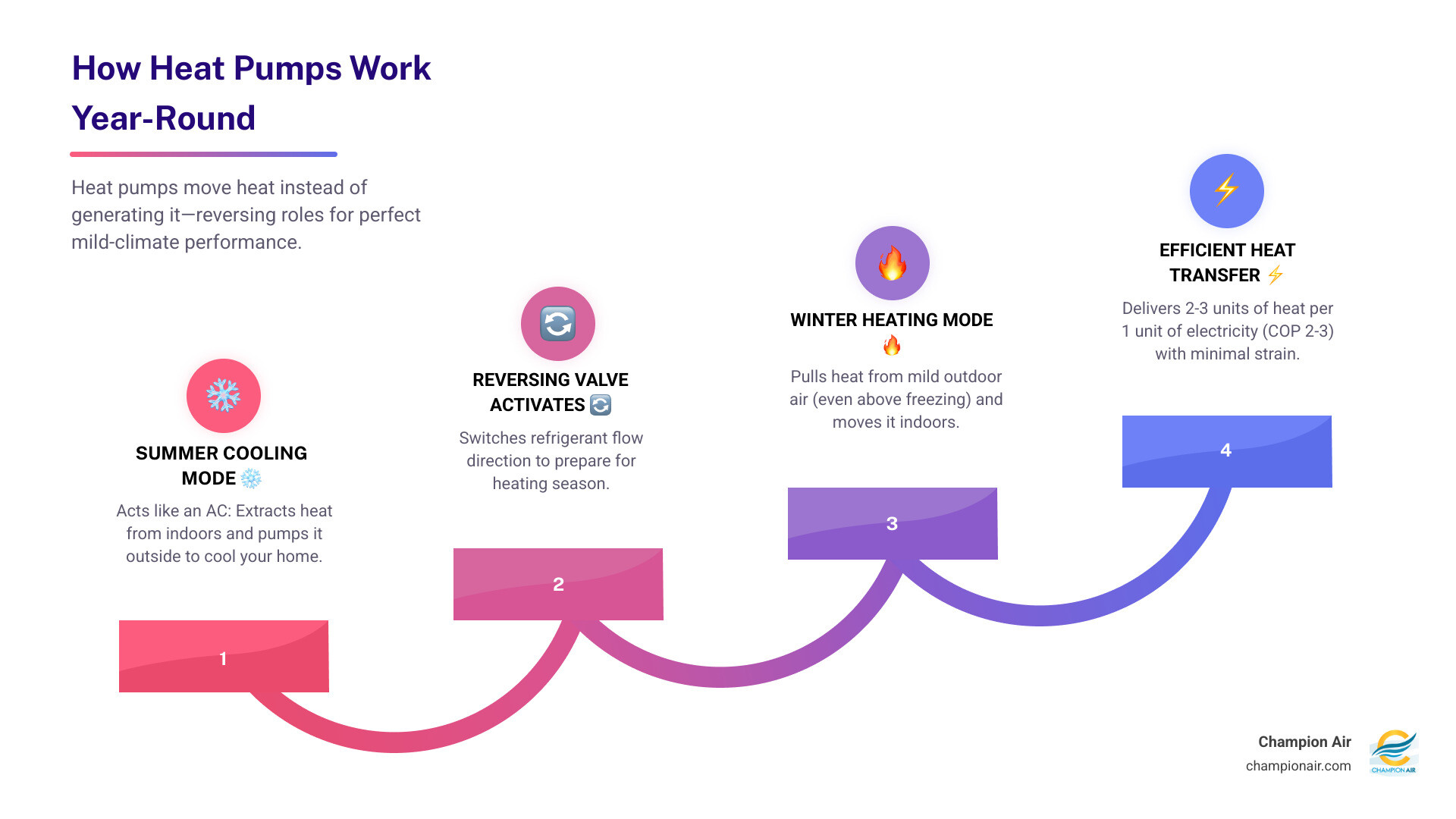
Heat pump advantages for mild winter climates
A heat pump does not create heat by burning fuel. It moves heat from one place to another using refrigerant, coils, and a compressor. In summer, it works like an air conditioner and pushes indoor heat outside. In winter, a reversing valve changes the refrigerant flow so the system can pull heat from the outdoor air and move it indoors.
That sounds almost suspiciously simple, but that is exactly why heat pumps shine in Arizona. When winter outdoor temperatures stay relatively moderate, the system has an easier job gathering heat from the air. Less strain means better efficiency, steadier comfort, and less need for any backup heat.
If you want a broader comparison of system types, our guide on air conditioners vs. heat pumps is a helpful place to start. We also cover why heat pumps are a strong fit for Arizona.
How heat pumps work and why mild air helps
Even when outdoor air feels cool to us, it still contains heat energy. A heat pump captures that energy through the outdoor coil, transfers it into the refrigerant, compresses it to raise the temperature, and then releases that heat inside your home.
In mild winter climates, that process stays efficient because the outdoor unit is not fighting severe temperature drops for long stretches. Research consistently shows heat pumps can maintain a COP of about 2 to 3 in mild conditions. In plain English, that means they can deliver 2 to 3 units of heat for every 1 unit of electricity they use. Some studies also show an average COP around 2.7 between 14 and 41 degrees, which is more than twice the heat output for the electricity consumed.
That matters in Scottsdale, Phoenix, Mesa, and nearby areas because our winter temperatures are usually well within a heat pump's comfort zone. A properly selected system can handle the vast majority of heating needs without drama, panic, or the HVAC equivalent of heavy lifting.
For a deeper look at the mechanics, see how a heat pump works.
Why heat pump advantages for mild winter climates stand out versus fuel-burning heat
In a mild climate, a furnace can be a bit like using a leaf blower to cool your soup. It gets the job done, but it is not always the most elegant solution.
Fuel-burning systems create heat through combustion. Heat pumps move existing heat. Because moving heat is usually more efficient than making it from scratch, heat pumps often deliver better seasonal efficiency in moderate winter weather.
A few key reasons they stand out in Arizona:
- They avoid on-site combustion for heating
- They do not produce carbon monoxide as part of normal heating operation
- They match lighter winter heating loads well
- They can run longer, lower-output cycles for steadier comfort
- They eliminate the need for a separate AC and heating appliance in many homes
That combination is a big reason heat pumps have long been common in warm and moderate climates. In Arizona, where cooling is a major part of annual HVAC use and heating needs are usually lighter, the all-in-one design makes a lot of sense.
The biggest homeowner benefits in mild winter regions
For many homeowners, the biggest win is not a spec sheet number. It is how the house feels day to day.

More consistent comfort with fewer temperature swings
Traditional heating systems often deliver short bursts of very warm air, then shut off until the house cools again. That can create the classic hot-cold-hot-cold cycle many homeowners know too well.
Heat pumps, especially variable-speed models, are designed to run in longer, gentler cycles. Instead of blasting heat and disappearing, they maintain a steadier indoor temperature. That is ideal for Arizona's winter pattern, where mornings can feel chilly and afternoons warm up quickly.
Benefits of this style of heating include:
- Fewer hot and cold spots
- Less noticeable temperature swing between cycles
- More even airflow
- Better "set it and forget it" comfort
- Less short cycling in mild weather
That softer, steadier delivery is one reason many homeowners find heat pumps more comfortable than they expected. On a cool desert morning, you want warmth without your house feeling like a toaster oven for ten minutes.
One system for winter heat and summer cooling
This is one of the most practical advantages of all. A heat pump gives you heating and cooling in one system.
In summer, it works like a standard central air conditioner. In winter, it reverses operation and brings heat indoors. That makes heat pumps especially attractive in Arizona, where summers are long and cooling performance matters just as much as winter heating.
This flexibility works well across different home setups:
- Ducted central systems
- Ductless mini-splits
- Zoned applications
- All-electric homes
- Homes planning for solar compatibility
Because Arizona homes typically need cooling far more often than heating, it makes sense to choose a system that is doing useful work year-round, not sitting idle half the time. If you are wondering whether you need much heating at all, our blog on whether you need a heating system in AZ can help frame that decision.
Quiet, safe, and low-hassle operation
Heat pumps are often quieter than homeowners expect. They do not have burner ignition noise, combustion rumble, or the same kind of abrupt heating startup some older systems have. Many modern units also include quieter fan designs and variable-speed technology that reduce noticeable sound.
If quiet performance matters to you, take a look at whether heat pumps are quieter than air conditioners.
Maintenance is also straightforward. In a mild climate, routine care usually means:
- Changing filters regularly
- Keeping the outdoor unit clear
- Cleaning coils when needed
- Scheduling annual professional service
- Checking refrigerant, airflow, and controls
Since a heat pump handles both heating and cooling, regular maintenance is especially important. One tune-up plan helps protect year-round comfort. For more on upkeep, see our guide to heat pump maintenance in Mesa, AZ.
Is a heat pump right for every home in a mild climate?
Not every home is an automatic yes. Mild climate does not erase the need for good system design.
A heat pump performs best when the equipment, ductwork, insulation, and airflow all work together. That is why we always recommend a whole-home evaluation instead of assuming any one-size-fits-all answer.
Heat pump advantages for mild winter climates depend on proper sizing
Proper sizing is one of the most important factors in heat pump performance. A contractor should use a real load calculation, often called a Manual J, rather than simply matching the old system's tonnage.
Why that matters:
- An oversized system can short cycle, waste energy, and control temperature poorly
- An undersized system may struggle on the coldest mornings or hottest summer days
- Leaky ducts can reduce comfort and efficiency
- Poor insulation and air leaks make any HVAC system work harder
- Window quality and sun exposure affect load significantly in Arizona
This is especially important in our service area, where cooling demand is often intense and shoulder-season temperatures can swing a lot in one day. Right-sizing the equipment helps the system stay efficient in winter without sacrificing summer performance.
Homes that are great candidates and when to think twice
Many Arizona homes are excellent candidates for heat pumps, especially if they have:
- Reasonable insulation levels
- Sound ductwork or a good mini-split layout
- An aging AC and heating setup ready for replacement
- Interest in all-electric comfort
- A need for both reliable cooling and light-to-moderate winter heating
There are also situations where we would want to look more carefully:
- Older homes with major insulation or air leakage issues
- Duct systems with poor airflow or heavy losses
- Install locations with limited outdoor unit clearance
- Homes where electrical upgrades may be needed
- Homeowners with very specific preferences for fast, high-temperature heat
In mild climates, backup heat is rarely needed for normal conditions, but supplemental heat may still be considered for unusual cold snaps or specific home layouts. The key is not assuming more backup is always better. In many homes, a properly selected heat pump already covers 90 to 100 percent of the heating load.
What to look for when shopping for a heat pump in a mild climate
Efficiency labels can look like alphabet soup, but a few metrics matter most.
| Rating | What it measures | Why it matters in Arizona |
|---|---|---|
| SEER2 | Seasonal cooling efficiency | Very important because summer cooling demand is high |
| HSPF2 | Seasonal heating efficiency | Important for winter operating cost and mild-weather heating performance |
| COP | Instant heating efficiency at a given condition | Helpful for understanding how efficiently the system moves heat |
Best efficiency ratings for mild winter performance
For mild climates, HSPF2 and SEER2 are the big numbers to review. Research suggests that for mild winter conditions, an HSPF2 of 7.5 or higher is a solid target. Because Arizona is also a cooling-heavy climate, strong SEER2 performance matters just as much, and often more, over the course of the year.
A few shopping tips:
- Look for strong SEER2 ratings for long, hot summers
- Aim for HSPF2 7.5 or better for efficient winter heating
- Review AHRI matched system data, not just a single component
- Ask how the unit performs at lower winter temperatures, even if extremes are rare
- Consider Energy Star certification when available
SEER2 and HSPF2 are useful because they reflect updated testing standards intended to be closer to real-world operation. That gives homeowners a better apples-to-apples comparison than older ratings alone.
Features that improve comfort in Arizona-style weather
Numbers matter, but features matter too. In our climate, we often recommend prioritizing comfort and modulation features, not just headline efficiency.
Helpful features include:
- Variable-speed or inverter-driven compressors
- Two-stage operation
- Smart thermostat compatibility
- Strong defrost controls
- Quiet fan design
- Durable outdoor cabinet construction
- Good low-ambient performance for colder mornings
- Zoning or ductless options where room-by-room control helps
Variable-speed systems are especially valuable because they adjust output to match the home's needs instead of running full blast every time. That improves comfort, reduces temperature swings, and often helps with efficiency.
You can browse current heat pump options here.
Real-world performance, environmental gains, and common questions
Heat pumps are not a niche technology anymore. They have been used successfully in warm and moderate climates for decades, and modern systems have only gotten better.
Where heat pumps are already succeeding in mild winter climates
Real-world use strongly supports what the data says: mild climates are where heat pumps are most naturally at home.
Common successful use cases include:
- Homes with short, moderate winters
- Areas with design temperatures around 25 to 35 degrees
- Homes that need far more cooling than heating
- Households wanting an all-electric HVAC setup
- Homes where even, quiet comfort matters more than fast furnace blasts
Research shows that in mild climates, standard heat pumps can handle 90 to 100 percent of annual heating needs, often with little or no backup operation. That tracks well with Arizona conditions, where true winter extremes are uncommon and daytime warming is frequent.
Environmental benefits and long-term value
Heat pumps can reduce emissions because they move heat efficiently instead of burning fuel on site. As the electric grid gets cleaner over time, the environmental advantage can grow as well.
Other long-term value points include:
- No on-site combustion during heating
- Lower carbon emissions in many homes
- Compatibility with all-electric home goals
- Good fit with solar-equipped homes
- Long service life with proper maintenance
A well-maintained heat pump can last a long time, with some systems reaching up to 25 years in favorable conditions. If you want more detail, read how long heat pumps last.
A 2024 NREL study found that roughly 65 million U.S. households could lower energy use by switching to air-source heat pumps even without subsidies. In mild winter climates, the practical benefits tend to be even more favorable because the equipment spends more of its time operating in efficient temperature ranges.
Common concerns: rebates, upkeep, and rare drawbacks
Homeowners usually ask the same fair questions.
Are rebates available? Sometimes, yes. Programs can include federal tax credits and utility or local incentives, depending on the year and your location. These change, so it is worth checking current eligibility before installation.
Is maintenance difficult? No, but it is important. Because one system handles both heating and cooling, annual service is smart. Filters, coils, airflow, and controls all need attention.
What about cold snaps? Modern heat pumps can still operate in low temperatures, and some cold-climate models work in conditions far below what Arizona typically sees. In our area, that extra capability is usually more reassurance than necessity.
Are there drawbacks? A few potential ones:
- Poorly insulated homes may not get the comfort results they expect without envelope improvements
- Bad sizing or installation can undermine efficiency
- Some homeowners prefer the feel of hotter supply air from a furnace
- During power outages, a heat pump still depends on electricity, just like central AC
If you are considering a replacement or want a professional recommendation, our heat pump service page is a good next step.
Frequently asked questions about heat pump advantages for mild winter climates
Do heat pumps need backup heat in mild winter areas?
Usually, not much. In mild climates, heat pumps can often cover 90 to 100 percent of annual heating needs. Some systems include supplemental heat for rare extremes, but in most Arizona homes it does not run often. The goal is to size the system correctly, not to assume heavy backup heat is necessary.
Will a heat pump keep my home comfortable on chilly Arizona mornings?
Yes, if it is properly selected and installed. Heat pumps are very good at maintaining steady indoor temperatures during moderate winter weather. Variable-speed systems are especially effective because they adjust output gradually instead of cycling between too much heat and not enough.
Are heat pumps a smart fit for homes in Scottsdale, Phoenix, and Mesa?
In many cases, yes. Our local climate is one of the strongest arguments for them. Heat pumps line up well with Arizona's combination of mild winters, long cooling seasons, and growing interest in efficient all-electric systems. The biggest decision factors are your home's insulation, ductwork, size, electrical setup, and comfort goals.
Conclusion
For homeowners in Scottsdale, Phoenix, Mesa, and surrounding areas, a heat pump is often the simplest answer to a very Arizona problem: how do you stay comfortable through mild winters and brutal summers without overcomplicating your HVAC system?
The answer is a system built for both.
The biggest heat pump advantages for mild winter climates are clear: strong efficiency, steady comfort, quieter operation, no on-site combustion, and year-round heating and cooling from one piece of equipment. In a climate like ours, that is not just practical. It is hard to beat.
If you are thinking about upgrading your home comfort system in Scottsdale, Phoenix (North & West Valley), or Mesa (South Valley), Champion Air Conditioning & Heating can help you evaluate whether a heat pump is the right fit for your home, ductwork, and comfort goals. Learn more about our heat pump installation services.
About the Author
Champion Air
More Articles
View All PostsKeep Reading
Related Articles


Ready to Get Started?
Whether you need a repair, maintenance, or a new installation, our expert team is here to help.