The Cold Hard Truth About Why Your AC Is Not Cooling Properly
Champion Air
Discover why is my ac blowing warm air in arizona heat: dust, leaks, coils & more. Fix it fast with Champion Air's Phoenix AC repair tips!
The Cold Hard Truth About Why Your AC Is Not Cooling Properly
When Your AC Blows Warm Air in Arizona Heat, Every Minute Counts
Why is my ac blowing warm air in arizona heat is one of the most urgent questions a Phoenix homeowner can face — and the answer is almost always one of these common causes:
- Wrong thermostat settings — the system is set to "Heat" or the fan is set to "On" instead of "Auto"
- Clogged air filter — desert dust blocks airflow, triggering a safety shutoff on the compressor
- Tripped circuit breaker — the outdoor unit loses power while the indoor fan keeps blowing
- Low refrigerant — a leak prevents the system from absorbing heat effectively
- Frozen evaporator coils — restricted airflow or low refrigerant causes ice buildup that blocks cooling
- Dirty condenser coils — dust and debris prevent the outdoor unit from releasing heat
- Failed capacitor — a heat-damaged electrical component stops the compressor from starting
- Peak heat overload — temperatures above 110°F can push even a healthy AC beyond its design limits
Phoenix summers are relentless. With outdoor temperatures regularly climbing past 110°F and AC systems running 12 to 16 hours a day, even a small problem that goes unnoticed in spring can turn into a full breakdown by July or August. When your home loses cooling in that kind of heat, it stops being a comfort issue and becomes a safety issue fast.
The good news? Many of the causes above are diagnosable in minutes. Some you can fix yourself. Others need a licensed technician right away.
I'm Barry Farah, and leading one of Arizona's largest residential HVAC replacement companies has given me a front-row seat to exactly why is my ac blowing warm air in arizona heat — and what it takes to fix it fast. In this guide, I'll walk you through every major cause, what to check first, and when to pick up the phone.
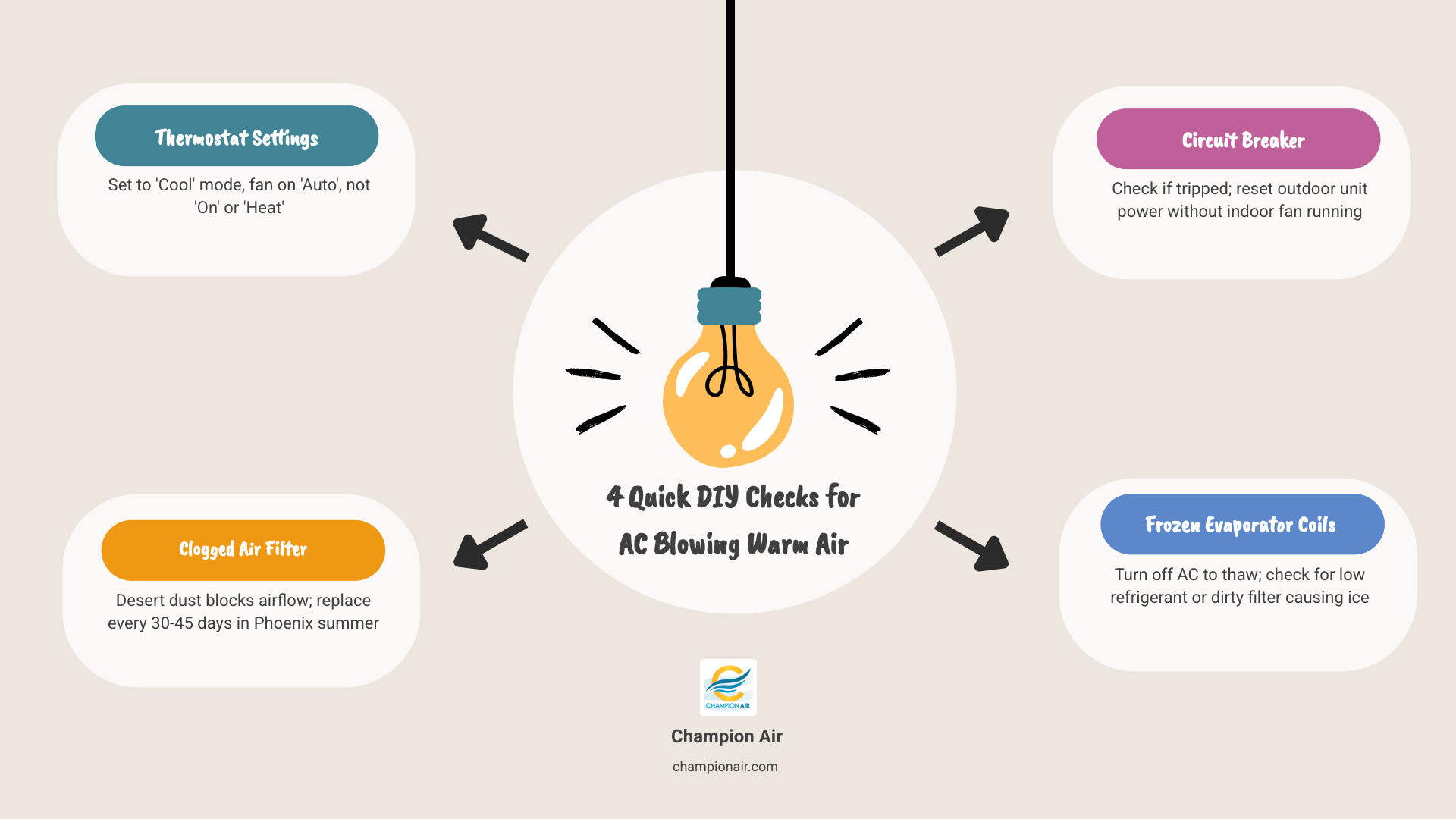
Common Culprits: Why Is My AC Blowing Warm Air in Arizona Heat?
When the vents start pushing out lukewarm air, it’s easy to panic and assume the entire system has kicked the bucket. However, we often find that the solution is much simpler. Before you start mourning your cooling system, there are a few basic checks you should perform.
Check Your Thermostat Settings
It sounds almost too simple, but it happens more often than you’d think. During routine cleaning or a seasonal transition, a thermostat can easily be bumped or switched to the "Heat" mode. First, verify that your thermostat is firmly set to "Cool." Next, check the temperature setting; it should be at least 3 to 5 degrees lower than the current room temperature to trigger a cooling cycle.
Another common issue is the fan setting. If your fan is set to "On" instead of "Auto," the blower will run 24/7. This means that even when the cooling cycle is off, air is still moving through your home. Since the compressor isn't running to remove heat, that air will feel warm. Switching to "Auto" ensures the fan only blows when the air is actually being cooled. For more tips on this, check out our guide on Why Is My AC Not Cooling?.
Tripped Circuit Breakers and Power Fluctuations
In the middle of an Arizona heatwave, the local power grid is under immense stress. Power fluctuations or surges can cause your AC's circuit breaker to trip. Interestingly, your indoor unit and outdoor unit usually run on separate breakers. If the outdoor condenser's breaker trips but the indoor unit remains powered, your vents will continue to blow air—it just won't be cold.
Check your home’s electrical panel for any switches that have moved to the "Off" or middle position. If you reset the breaker and it trips again immediately, do not try a second time. This indicates a serious electrical fault that requires professional attention. You can learn more about these common electrical hurdles in our article on Common HVAC Issues & Troubleshooting.

The Impact of Desert Dust and Extreme Temperatures
Living in the Valley of the Sun means dealing with unique environmental factors that most HVAC systems in other parts of the country never face. From Mesa to Surprise, the desert environment is a major reason why is my ac blowing warm air in arizona heat.
Haboobs and Dust Storms
Arizona's monsoon season brings spectacular dust storms, known as haboobs. While they are a sight to behold, they are a nightmare for your AC. These storms kick up fine silt and sand that can clog a standard air filter in just a few days. When the filter is blocked, the system can't "breathe." This restricted airflow causes the internal components to overheat, often leading the compressor to shut down as a safety precaution while the fan continues to run.
This is Why Changing Air Filters Is So Important. In milder climates, you might get away with changing filters every 90 days. In Phoenix, that’s a recipe for disaster.
| Maintenance Task | Standard Climate Schedule | Arizona Desert Schedule |
|---|---|---|
| Filter Replacement | Every 90 Days | Every 30-45 Days (Monthly in Summer) |
| Condenser Cleaning | Once a Year | Twice a Year (Especially after Monsoons) |
| Professional Tune-Up | Annual | Bi-Annual (Spring & Fall) |
| Outdoor Unit Inspection | Seasonal | Monthly during 110°F+ months |
Dirty Condenser Coils and UV Exposure
The outdoor portion of your AC is called the condenser. Its job is to release the heat collected from inside your home into the outdoor air. What Does an AC Condenser Do? It acts as a heat exchanger, but it can’t do its job if it’s coated in dust or blocked by debris.
Extreme UV radiation in Scottsdale and Peoria also takes a toll, degrading the insulation on refrigerant lines and wearing down electrical components. Furthermore, ensure you have at least 2 to 3 feet of clearance around your outdoor unit. If you have bushes, tall grass, or storage items crowding the unit, the heat it’s trying to release will just get sucked back in, causing the system to blow warm air.
Mechanical Failures Caused by the Phoenix Summer Stress Test
When temperatures exceed 110°F for weeks on end, your AC is essentially running a marathon every single day. Most systems in Phoenix run 12 to 16 hours daily during peak summer. This "stress test" leads to specific mechanical failures.
The Mystery of Frozen Evaporator Coils
It seems impossible—how can an AC unit freeze when it's 115°F in Gilbert? Yet, frozen evaporator coils are a top reason for warm air. If airflow is restricted (due to that dirty filter we mentioned) or if refrigerant levels are low, the pressure inside the coils drops. This causes the temperature of the coils to fall below freezing, turning any moisture in the air into ice. Once the ice builds up, it acts as an insulator, preventing the system from cooling your home.
If you see ice on the copper lines or the indoor unit, turn the AC off immediately and set the fan to "On" to help it thaw. Then, follow our guide on How to Troubleshoot Your HVAC System for Optimal Performance or give us a call.
Component Wear and Tear
Constant operation causes the metal parts in your system to expand and contract significantly. This thermal expansion is a leading cause of refrigerant leaks. Additionally, the sheer volume of work the system does in Arizona means that a unit that might last 20 years in the Midwest may only last 10 to 12 years here. Understanding How Long Should My AC Run in Arizona? can help you gauge if your system is overworking itself.
Identifying why is my ac blowing warm air in arizona heat due to refrigerant leaks
Refrigerant is the lifeblood of your cooling system. It doesn't get "used up" like gasoline in a car; it circulates in a closed loop. If your system is low, you have a leak.
Common Signs Your Air Conditioner Is Low in Freon include:
- Hissing or bubbling noises near the refrigerant lines.
- The system running constantly but the temperature inside never dropping.
- Ice on the evaporator coils or outdoor lines.
Handling refrigerant requires EPA certification, so this is never a DIY fix. A technician must find the leak, seal it, and then recharge the system to the correct level. Ignoring a leak puts massive strain on your compressor, which is the most expensive part of the system to replace.
Electrical strain and why is my ac blowing warm air in arizona heat
The intense heat in places like Chandler and Buckeye is particularly hard on electrical components. The "start capacitor" is like a large battery that gives your compressor the jolt of energy it needs to start up. These capacitors are prone to bulging or "popping" in extreme heat. If the capacitor fails, the outdoor fan might spin, but the compressor won't start, resulting in—you guessed it—warm air.
Voltage drops during peak usage hours in the Valley can also cause motor contactors to wear out or wiring to degrade. If you suspect an electrical failure, our AC Repair Service in Phoenix can safely diagnose and replace these high-voltage parts.
When to Call a Professional for Emergency Repairs
While we encourage homeowners to check their filters and thermostats, there are times when DIY troubleshooting needs to stop for your own safety and the health of your equipment.
You should call for Emergency HVAC Repair immediately if:
- You hear unusual noises: Grinding, screaming, or loud banging sounds indicate mechanical failure.
- You smell burning: An electrical "ozone" smell or the scent of burning plastic means wires are melting.
- The breaker keeps tripping: This is a sign of a short circuit or a grounded compressor.
- There is no airflow at all: This could be a failed blower motor.
- The system is over 12 years old: If you’re facing frequent repairs on an aging unit, it might be time to discuss replacement options that are better suited for the modern Arizona climate.
Frequently Asked Questions about Arizona AC Performance
How often should I change my air filter during a Phoenix summer?
In the Phoenix Valley, we recommend checking your filter every 30 days. If you have pets, live near a construction site, or if we’ve recently had a haboob, you might need to change it every 3 weeks. Keeping a clean filter is the cheapest way to prevent your AC from blowing warm air.
Why is there ice on my AC unit when it is 110 degrees outside?
Ice is a sign of a pressure imbalance. It’s usually caused by either a lack of airflow (dirty filter/blocked vents) or a lack of refrigerant (a leak). When the pressure drops too low, the coil temperature plummets, freezing the moisture in the air into a block of ice.
Can my AC keep my house at 75°F when it is 115°F outside?
Most AC systems are designed to create a 20-degree differential between the outdoor air and the indoor air. When it hits 115°F, your system is working at its absolute limit to reach 75°F. To help it out, keep your blinds closed, avoid using the oven during the day, and ensure your attic insulation is up to par. If your system can't even get within 20 degrees of the outdoor temp, there’s likely an underlying issue.
Conclusion
At Champion Air, we know that a broken AC in the middle of a July afternoon is more than a nuisance—it’s a crisis. Whether you’re in Scottsdale, Mesa, or anywhere in the Greater Phoenix area, our team is ready to help you find the "cold hard truth" about your cooling problems.
Don't wait for a small puff of warm air to turn into a total system meltdown. Our HVAC Maintenance Plans are designed to catch these desert-specific issues before they leave you sweating. We offer 24/7 emergency service with no overtime charges, because we believe you shouldn't be penalized for a breakdown that happens after 5 PM.
Schedule your professional AC repair in Phoenix today and let us get your home back to the oasis it should be.
About the Author
Champion Air
More Articles
View All PostsKeep Reading
Related Articles


Ready to Get Started?
Whether you need a repair, maintenance, or a new installation, our expert team is here to help.