How Your Air Conditioner Works Explained Simply for Sweaty Humans
Champion Air
Discover how your air conditioner works: refrigeration cycle, key components, dehumidification & efficiency tips for Arizona homes.
How Your Air Conditioner Works Explained Simply for Sweaty Humans
What Every Arizona Homeowner Should Know About How Your Air Conditioner Works
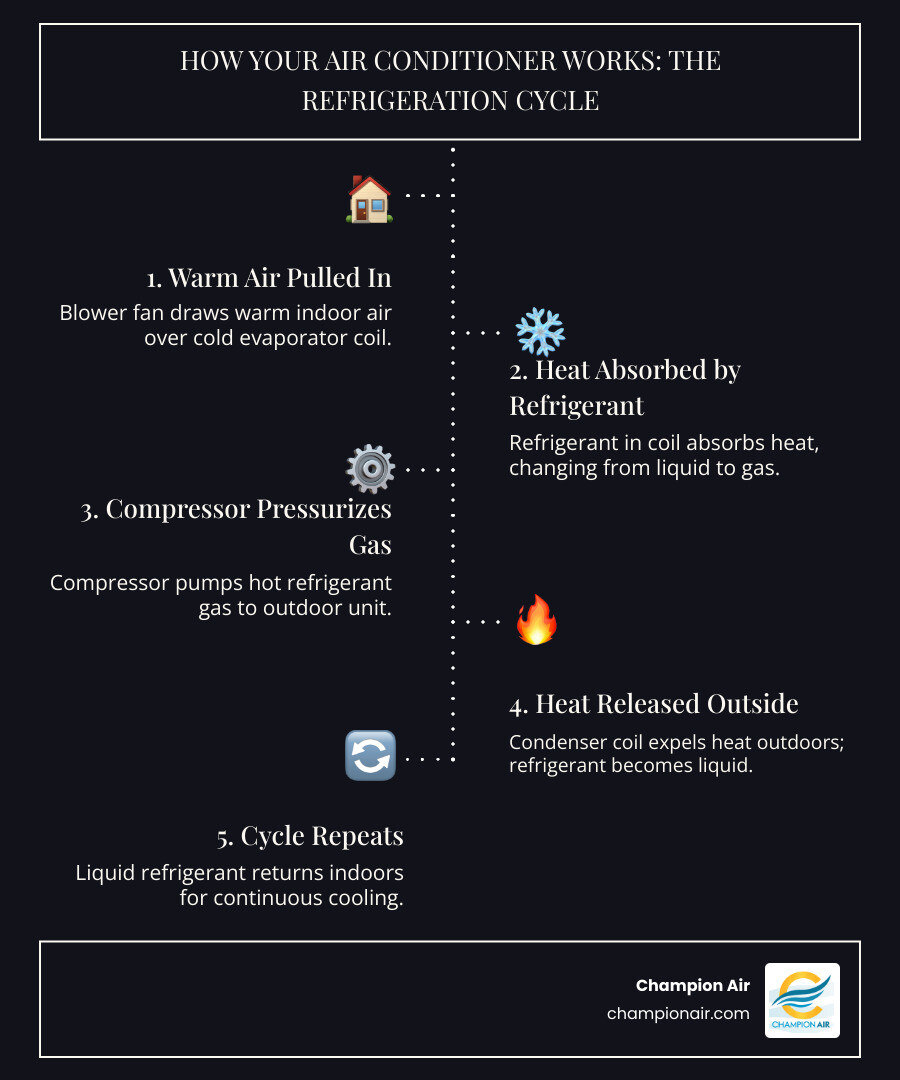
How your air conditioner works comes down to one simple idea: it doesn't create cold air — it moves heat out of your home. Here's the quick version:
- Warm indoor air is pulled across a cold evaporator coil inside your home.
- Refrigerant inside that coil absorbs the heat and turns from liquid into gas.
- The compressor pushes that hot gas to the outdoor unit.
- The condenser coil releases the heat outside, and the refrigerant turns back into a liquid.
- The cycle repeats continuously until your home reaches the temperature you set.
That loop — absorbing heat indoors, dumping it outdoors — is the entire secret behind every air conditioner ever made.
It sounds simple, but there's a lot happening inside that system every time Arizona's summer heat climbs past 110°F. When something goes wrong — or when you're wondering why your energy bill is creeping up — understanding the basics helps you make smarter decisions about your home's comfort and safety.
The modern version of this process traces back to July 17, 1902, when Willis Carrier invented the first electrical air conditioning system. What started as a solution to a humidity problem at a Brooklyn printing plant became one of the most transformative inventions in human history. Today, an estimated 1.6 billion AC units are in use worldwide — and that number is projected to nearly triple to 4 billion by 2050.
For Arizona homeowners, this isn't just a convenience. It's a safety system.
I'm Barry Farah, and leading Arizona's largest Lennox family-owned residential replacement HVAC company has given me a front-row seat to every way an AC system can perform brilliantly — or fail completely — in our brutal desert climate. Understanding how your air conditioner works is the first step toward keeping your family cool, safe, and comfortable all summer long.
The Science of How Your Air Conditioner Works
To understand the magic behind your cooling system, we have to look at the laws of thermodynamics. While it feels like your AC is "making cold," it is actually performing a process of heat subtraction. In physics, "cold" isn't a thing you can create; it is simply the absence of heat.
The core principle at play here is "phase conversion." This is a fancy way of saying that when a liquid turns into a gas, it absorbs a massive amount of energy (heat) from its surroundings. Think about how your skin feels chilly when you step out of a swimming pool in Scottsdale. That’s the water evaporating off your skin, taking your body heat with it. Your air conditioner does the exact same thing, just on a much larger, more controlled scale.
Efficiency is a major part of this science. In May 2026, homeowners are more focused than ever on how much energy this process consumes. This is where Everything to Know About SEER Ratings becomes vital. SEER, or Seasonal Energy Efficiency Ratio, measures how much cooling a system provides for every watt of electricity it uses. While older units might struggle with low efficiency, modern systems can reach SEER ratings as high as 26, significantly lowering your monthly utility bills.
Understanding the Refrigeration Cycle and How Your Air Conditioner Works
The refrigeration cycle is a closed-loop system, meaning the refrigerant stays inside the copper coils and never actually "touches" the air in your home. It’s a continuous hand-off of heat.
The cycle starts indoors, where the refrigerant is a cold, low-pressure liquid. As warm air from your living room is blown over the indoor coils, the refrigerant soaks up that heat. This causes the refrigerant to boil and turn into a gas. This gas then travels to the outdoor unit. This is where the What Does AC Condenser Do comes into play. The outdoor unit’s job is to take that captured heat and dump it into the Arizona sky, even when it's already 110°F outside.
The Role of Refrigerant in How Your Air Conditioner Works
Refrigerant is the "blood" of your AC system. It is a specialized chemical compound designed to change states from liquid to gas at very low temperatures. For decades, the industry used chlorine-based coolants, but due to the Montreal Protocol and environmental concerns, these have been phased out.
Most modern systems in Phoenix and Mesa use R-410A, a more environmentally friendly refrigerant. The beauty of refrigerant is its ability to be manipulated. By changing its pressure, we can force it to become incredibly cold (to absorb heat) or incredibly hot (to release heat). When the compressor squeezes this gas, it turns into a high-pressure vapor, which is essential for moving the heat effectively through the system.
The Four Essential Components of Your AC System
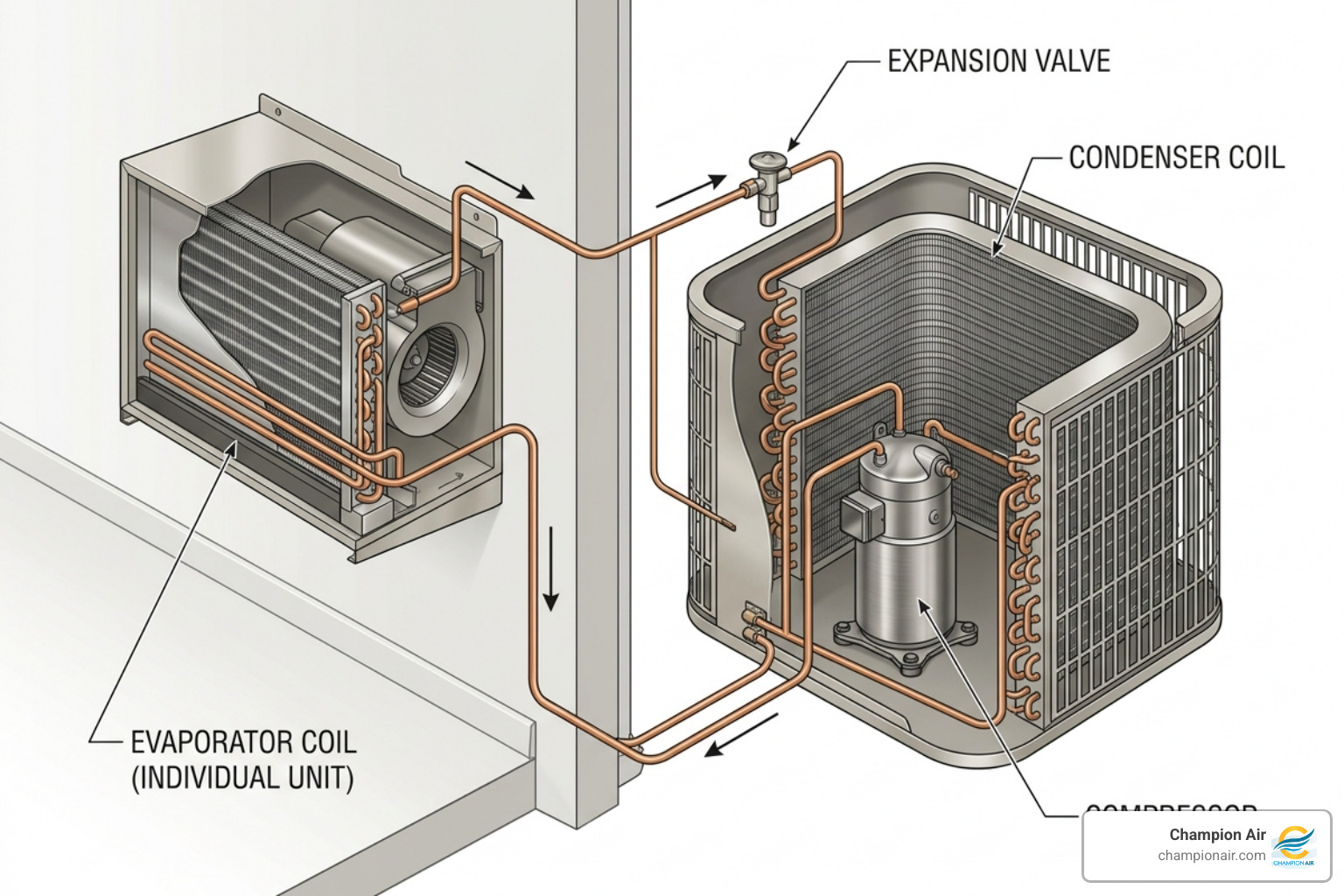
While an air conditioner has hundreds of small parts, the heavy lifting is done by four primary components working in perfect harmony. If any one of these fails, the whole system grinds to a halt.
- The Evaporator Coil: Located inside your home (usually in the attic or a closet).
- The Compressor: Located in the big box outside.
- The Condenser Coil: Also located in the outdoor unit.
- The Expansion Valve: The regulator that sits between the indoor and outdoor sections.
To protect your home from potential water damage during this process, many systems also include a safety device called a float switch. You can learn more about this in our guide on What Does AC Float Switch Do.
The Indoor Evaporator Coil
The evaporator coil is where the actual cooling happens. It consists of serpentine copper or aluminum tubing surrounded by thin metal fins. As the blower fan pulls warm, dusty air from your home through a filter, it pushes it across these ice-cold coils.
The refrigerant inside the coil is hungry for heat. As the air passes over, the heat is sucked into the refrigerant. At the same time, the air is filtered, removing allergens and dust before being pushed back through your ducts. This is why keeping your filters clean is the single best thing you can do for your system’s health.
The Outdoor Compressor and Condenser
If the evaporator is the lungs of the system, the compressor is the "heart." This component is responsible for circulating the refrigerant. It takes the low-pressure gas coming from the house and squeezes it until it becomes a high-pressure, high-temperature vapor.
Once pressurized, the gas moves into the condenser coil. A large fan pulls outdoor air across these coils, allowing the heat to escape into the atmosphere. This is why the air blowing out of the top of your outdoor unit feels like a hair dryer—that is literally the heat from your living room being evicted!
Many homeowners ask about the quality and origin of these heavy-duty components. If you've ever wondered Where Lennox Air Conditioners Made, you'll find that many are manufactured right here in North America, specifically designed to handle the high-stress environments of the Southwest.
Removing Heat and Humidity from Arizona Homes
In Arizona, we don't just deal with heat; we deal with the "Dry Heat" and the humid Monsoon season. How your air conditioner works to keep you comfortable involves a secret secondary job: dehumidification.
As warm air hits the cold evaporator coil, it reaches its "dew point." Just like a cold can of soda "sweats" on a patio in Gilbert, moisture in your home’s air condenses into liquid water on the AC coils. This water drips into a collection pan and is funneled outside through a condensate drain line.
During the Monsoon months, this process is critical. Removing humidity allows your sweat to evaporate more effectively, which makes you feel much cooler even if the temperature on the thermostat hasn't moved. However, this constant moisture can lead to wear and tear. Knowing How Long Do Air Conditioners Last in Arizona is important for planning, as our extreme heat and dust can shorten the lifespan of a system compared to milder climates.
Comparing Different Cooling System Types
Not every home in the Valley is built the same, which is why there are several ways to package these components.
| System Type | Best For | Main Benefit |
|---|---|---|
| Split-System | Most US Homes | Efficient, quiet, and uses existing ductwork. |
| Packaged Unit | Homes with limited space | All components in one outdoor cabinet (common on roofs). |
| Ductless Mini-Split | Home offices, additions | Zoned cooling without needing ducts. |
| Heat Pump | Moderate to Hot climates | Provides both heating and cooling in one unit. |
For many of our neighbors, the question isn't just about cooling, but also efficient heating for those chilly December nights. You might find it helpful to learn How Does a Lennox Heat Pump Work to see if a dual-purpose system is right for you. If you're looking for reliability, there are many reasons Why Buy a Lennox Air Conditioner, especially when it comes to durability in the desert.
Variable-Speed and Inverter Technology
Traditional air conditioners are like a light switch—they are either 100% on or 100% off. This leads to temperature swings and higher energy bills. Modern "Inverter" or variable-speed technology is more like a dimmer switch.
These systems can slow down or speed up based on exactly how much cooling you need. On a 90°F day in May, the system might run at only 30% capacity, using very little electricity. When it hits 115°F in July, it ramps up to 100%. This provides much more consistent temperatures and superior dehumidification. Plus, because the system isn't constantly "slamming" on and off, it reduces wear and tear. This is a big factor in How Long Do Lennox Air Conditioners Last, as smoother operation leads to a longer life.
Frequently Asked Questions About Air Conditioning
Does an air conditioner create cold air?
No! As we discussed, an air conditioner is a heat-removal machine. It takes the heat energy existing in your home and moves it outside. The "cool" air you feel coming out of the vents is simply your own indoor air that has had the heat and moisture stripped away from it.
Why does my air conditioner also act as a dehumidifier?
Dehumidification is a natural byproduct of the refrigeration cycle. When warm air meets a cold surface (the evaporator coil), the air can no longer "hold" the water vapor, so it turns into liquid. This is why a properly sized AC is so important; if the unit is too big, it will cool the house too fast and shut off before it has a chance to remove the humidity, leaving you feeling "clammy."
Does the outdoor unit pull fresh air into my house?
This is one of the biggest myths in HVAC. Your outdoor unit (the condenser) does not pull air from the outside into your home. The only thing moving between the indoor and outdoor units is the refrigerant inside sealed copper lines. The fan you see spinning on the outdoor unit is only there to blow air across the coils to cool down the refrigerant.
Conclusion
Understanding how your air conditioner works empowers you to take better care of your home and catch small problems before they become "no-cooling" emergencies in the middle of a Phoenix July. From the elegant science of phase conversion to the mechanical muscle of the compressor, your AC is a marvel of modern engineering.
At Champion Air, we've spent years perfecting the art of cooling in Scottsdale, Phoenix, Mesa, and the surrounding North and West Valley cities. Whether you're trying to figure out How to Clean Your Air Conditioner to keep it running smoothly or you're ready for a full system upgrade, we're here to help.
Don't wait until the next heatwave to ensure your system is up to the task. For 24/7 emergency repairs with no overtime charges and same-day service from licensed experts, reach out to us for Expert Air Conditioning Solutions in Arizona. Stay cool, Arizona!
About the Author
Champion Air
More Articles
View All PostsKeep Reading
Related Articles


Ready to Get Started?
Whether you need a repair, maintenance, or a new installation, our expert team is here to help.