The First Five Things to Check When Your Heat Pump Won't Start
Champion Air
Heat pump not turning on? Check thermostat, power, filter, outdoor unit & noises first. DIY fixes + when to call pros in AZ!
The First Five Things to Check When Your Heat Pump Won't Start
Is Your Heat Pump Not Turning On? Start Here
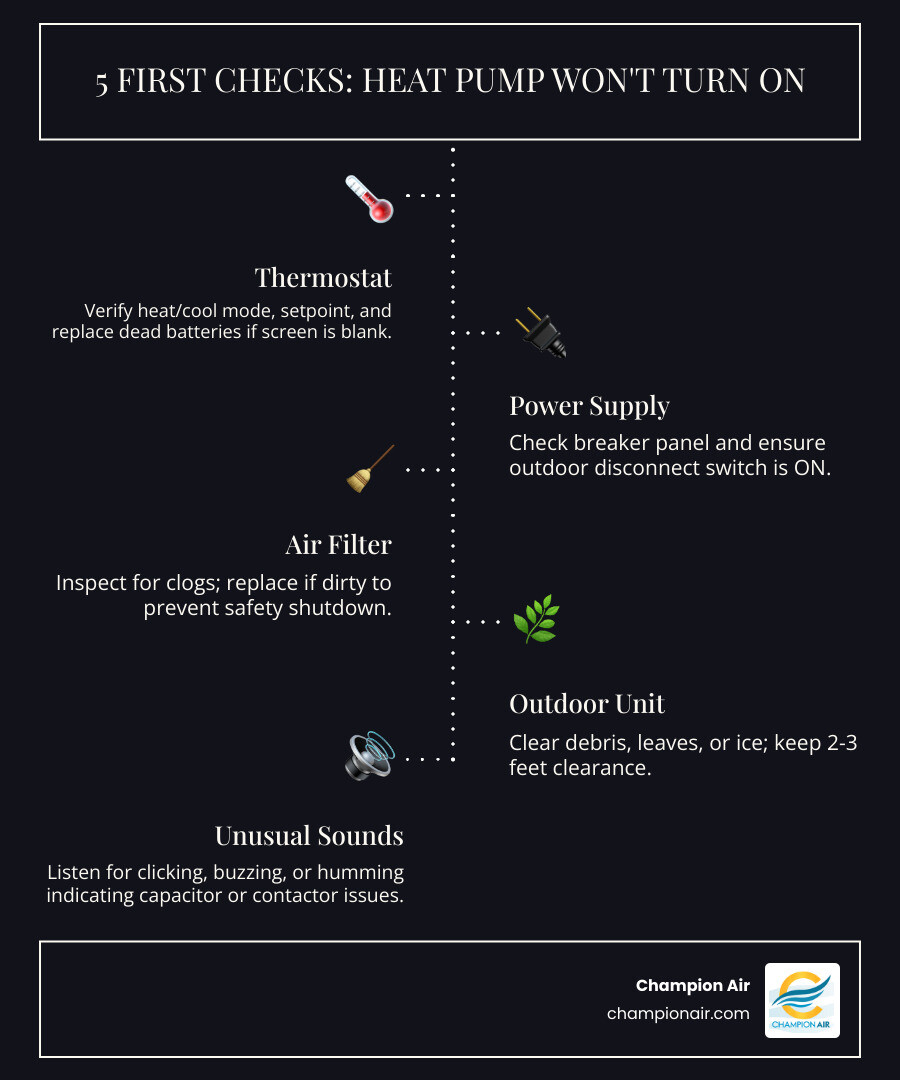
When your heat pump not turning on is the first thing you notice on a hot Arizona morning, here are the five things to check right away:
- Thermostat settings - Make sure it's set to the correct mode (heat or cool) and the temperature setpoint is active. Replace batteries if the screen is blank.
- Circuit breaker and power supply - Check your electrical panel for a tripped breaker. Confirm the outdoor disconnect switch is in the ON position.
- Air filter - A clogged filter can trigger an automatic safety shutdown. Inspect it and replace if dirty.
- Outdoor unit - Clear away leaves, debris, or ice buildup. Maintain at least 2 to 3 feet of clearance around the unit.
- Unusual sounds - Listen for clicking, buzzing, or humming when the unit tries to start. These sounds can point to a failed capacitor or contactor.
If any of these quick checks solve your problem, great. If not, keep reading — this guide walks you through each step in detail and tells you exactly when it's time to call a pro.
Your heat pump is one of the hardest-working systems in your Arizona home. It handles both heating and cooling year-round, which means when it stops responding, comfort disappears fast — and in the Phoenix valley heat, that's not just inconvenient, it can be a real safety concern. The good news? A surprising number of no-start calls come down to a handful of simple, fixable causes that you can check yourself in under 15 minutes. The research backs this up: the vast majority of heat pump startup failures trace back to basic issues like power interruptions, thermostat errors, dirty filters, or outdoor unit obstructions — not expensive mechanical failures.
This guide gives you a clear, logical starting point before you pick up the phone.
I'm Barry Farah, and over the years leading Champion Air — Arizona's largest Lennox family-owned residential replacement company — I've seen how often a heat pump not turning on comes down to something a homeowner can catch themselves with the right guidance. My goal here is to give you exactly that: a straightforward checklist so you know what to look for, what's safe to fix yourself, and when to call for expert help.
Heat Pump Not Turning On What to Check First
When your home begins to feel stuffy or the temperature starts creeping up past your comfort zone, it is easy to assume the worst. However, a heat pump is a complex machine with several built-in safety features designed to shut the system down if something isn't quite right. Understanding the "startup order" can help you identify where the failure is happening.
Typically, the process looks like this:
- The thermostat detects a temperature change and sends a 24V signal to the indoor air handler or furnace.
- The indoor fan starts to move air.
- The signal travels to the outdoor unit.
- The contactor (a high-voltage switch) closes, sending power to the compressor and the outdoor fan motor.
- The start capacitor gives the motors the "jolt" they need to begin spinning.
If your heat pump not turning on what to check first depends on where this chain is broken. If the indoor fan is blowing but the outdoor unit is silent, the problem is likely outside. If the whole system is dead, the issue is usually power or thermostat-related.
1. Check the thermostat settings and reset basics first
It sounds simple, but you would be surprised how often a "broken" heat pump is actually just a thermostat that was bumped, switched to the wrong mode, or ran out of juice. In our May 2026 service calls across Scottsdale and Peoria, we still find that minor settings are a leading cause of system downtime.
Mode and Setpoint
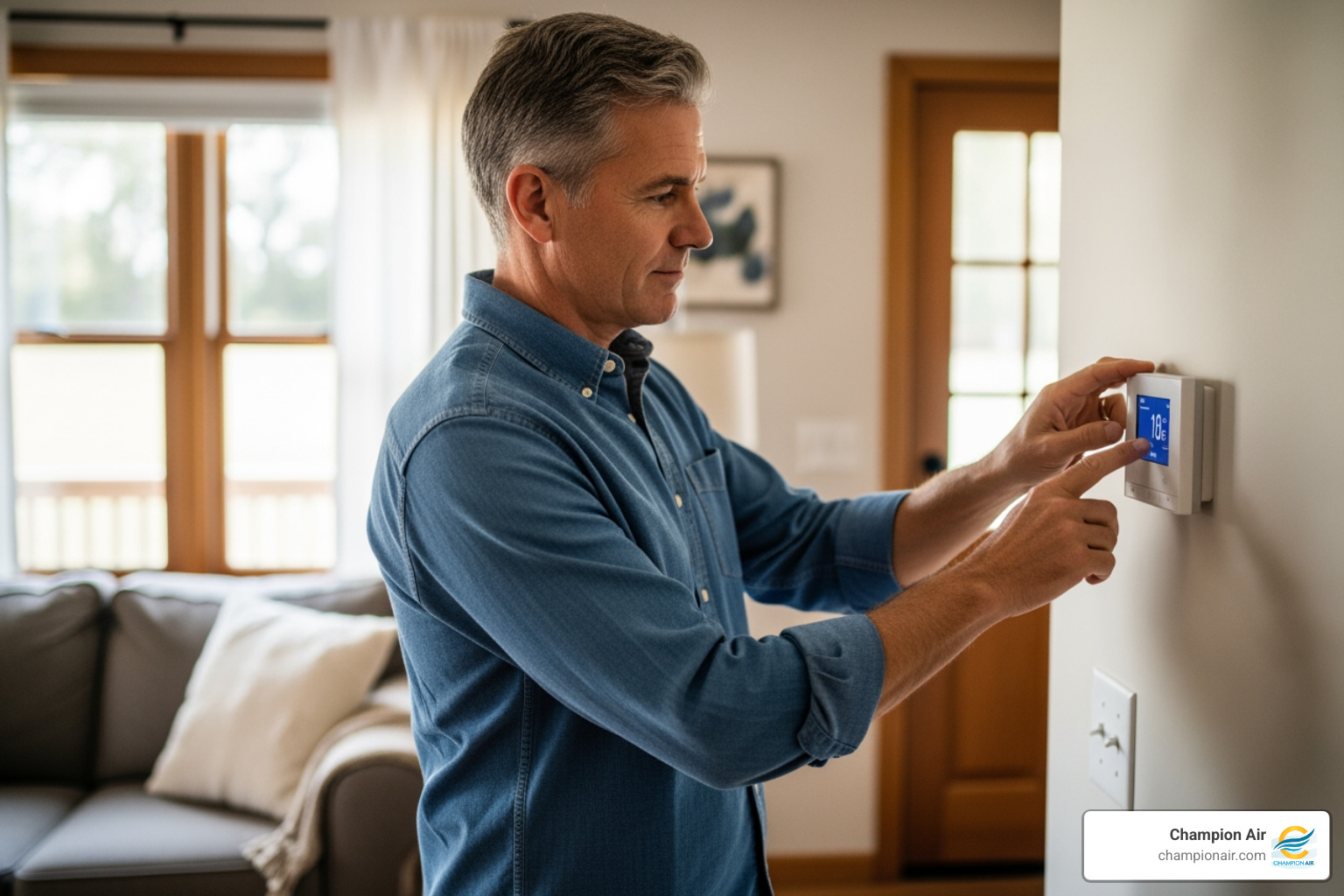
First, verify that the thermostat is actually set to "Cool" (in the summer) or "Heat" (in the winter). If it is set to "Off" or "Fan Only," the outdoor unit will never receive the signal to start. Next, check the temperature setpoint. For testing purposes, set the temperature at least 5 degrees below the current room temperature for cooling, or 5 degrees above for heating. Give the system about five minutes to respond, as many modern thermostats have a built-in "short-cycle" delay to protect the compressor.
Batteries and Power
If your thermostat screen is blank, it is likely a power issue. Most thermostats use two AA or AAA batteries as a backup or primary power source. If these are dead, the thermostat cannot communicate with your HVAC system. If your screen is still blank after a battery change, there may be a deeper wiring issue or a blown fuse on the control board. You can learn more about Why Thermostat Not Working to see if your control center is the culprit.
Compatibility and Savings
If you recently installed a new "smart" thermostat yourself, compatibility could be the reason your system won't start. Heat pumps require specific wiring (the O/B terminal) to control the reversing valve. If this isn't configured correctly, the system may blow air but won't provide the temperature you need. Properly configured units can offer significant All You Need to Know About Programmable Thermostat Savings, but they must be wired right to work at all.
2. Confirm the system actually has power
If the thermostat is fine but the system is completely unresponsive, it’s time to look at the electrical supply. Heat pumps pull a significant amount of electricity, especially during a Phoenix summer.
The Circuit Breaker
Head to your home’s main electrical panel. Look for a large double-pole breaker labeled "AC," "Heat Pump," or "HVAC." Even if it looks like it is in the "On" position, it may have "tripped" to a middle position. To reset it, flip it all the way to "Off" and then back to "On."
Important Safety Rule: You get one free reset. If the breaker trips again immediately or shortly after the unit starts, do not reset it again. A repeated trip indicates a short circuit, a grounded compressor, or a failing motor. Forcing it to stay on can cause a fire or permanent damage to your equipment.
The Outdoor Disconnect
Next to your outdoor unit, there is a small metal box mounted to the wall. This is the disconnect box. Inside, there is either a pull-out handle or a toggle switch. Ensure it is in the "On" position. Sometimes these are accidentally switched off during landscaping or home maintenance.
The Float Switch
In Arizona, your AC produces a lot of condensation. If your primary drain line gets clogged with algae or dust, the water will back up. Most modern systems in places like Chandler and Gilbert are equipped with a float switch. When the water level rises, the switch trips and cuts power to the system to prevent a flood in your home. Understanding What Does AC Float Switch Do can save you a lot of frustration, as simply clearing the drain line often brings the system back to life.
Heat pump not turning on what to check first outside and inside
If you have confirmed that the thermostat is calling for air and the power is on, but the system still isn't running correctly, we need to look at airflow and physical obstructions. A heat pump is essentially a heat transfer machine. If it cannot move air, it cannot move heat, and it will eventually shut itself down to prevent a total meltdown.
3. Inspect the air filter and airflow restrictions
We cannot stress this enough: a dirty air filter is the number one enemy of your HVAC system. In the dusty environment of the Phoenix valley, filters clog faster than the manufacturer's "90-day" suggestion might lead you to believe.
Shutdown Protection
When a filter is heavily clogged, the blower motor has to work twice as hard to pull air through the system. This leads to two major problems:
- Overheating: The blower motor or furnace components can overheat, causing a limit switch to trip and shut the system down.
- Freezing: In cooling mode, low airflow causes the evaporator coil to drop below freezing. Ice forms on the coil, eventually blocking all airflow and potentially sending liquid refrigerant back to the compressor, which can destroy it.
Heavy Use Intervals
For homes in areas like Surprise or Queen Creek, we recommend checking your filter every 30 days. If you have pets, live near a construction site, or have allergies, you should replace it monthly. A clean filter ensures your system can breathe. If you are unsure how to check your specific model, our guide on How to Troubleshoot Your HVAC System for Optimal Performance provides step-by-step instructions. Addressing these Common Issues Troubleshooting early can prevent a total system failure later.
4. Look around the outdoor unit for obstructions or ice buildup
The outdoor portion of your heat pump (the condenser) needs to "breathe" just as much as the indoor unit. If the aluminum fins are clogged or blocked, the system won't be able to release or absorb heat efficiently.
Coil Blockage and Clearance
Check the area around your unit. Arizona homeowners often try to hide their HVAC units with decorative fencing or bushes. While this looks nice, you must maintain at least 2 to 3 feet of clear space on all sides. If the unit is surrounded by weeds, fallen leaves, or "haboob" dust, the compressor will run hot and eventually shut down on a high-pressure safety switch.
The Defrost Cycle: Steam vs. Ice
In the winter months in Mesa or Apache Junction, you might see "smoke" coming off your unit. Don't panic! This is usually just steam from the defrost cycle. However, if the unit is encased in a thick block of ice that doesn't go away, you have a problem. This could be due to a faulty defrost board or low refrigerant. Never chip away at ice with a hammer or screwdriver. The refrigerant coils are fragile, and one slip could lead to an expensive leak.
For residents in the South Valley, our Heat Pump Maintenance in Mesa AZ: Your Go-To Guide for Affordable Top-Rated Service offers specific tips for keeping your outdoor unit clear. Understanding How Does Lennox Heat Pump Work can also help you distinguish between normal operation and a system-threatening blockage.
If the heat pump not turning on what to check first does not solve it
If you have checked the thermostat, the power, the filter, and the outdoor unit, and the system still refuses to start, we are likely looking at a component failure. This is where your ears become your best diagnostic tool.
5. Listen for clicking, buzzing, or humming before the unit shuts off
When you stand near the outdoor unit and someone turns the thermostat on, what do you hear? These sounds are clues to what is happening inside the electrical cabinet.
- A Loud Click: This is usually the contactor closing. If you hear the click but nothing else happens, the "call for service" has reached the unit, but the motors aren't receiving power or can't start.
- Humming or Buzzing: This often indicates a failed start capacitor. The capacitor is like a large battery that gives the motor a push. If it's dead, the motor will hum as it tries to start but eventually shuts off when it gets too hot.
- Rapid Clicking: This can be a sign of a low-voltage issue or a failing contactor that can't stay closed.
- Silence: If there is no sound at all, the outdoor unit isn't getting any signal from the thermostat or the power is cut off elsewhere.
If you notice Strange HVAC Noises You Can't Ignore, it's a clear signal that a mechanical or electrical part is reaching the end of its life.
What repeated breaker trips, frozen coils, or error codes usually mean
If you find yourself resetting the breaker more than once, or if you see ice forming on the copper lines leading into the house, these are "red flag" symptoms.
- Low Refrigerant: Causes the system to run constantly and eventually freeze up.
- Reversing Valve Failure: The system might turn on but blow the wrong temperature air (e.g., hot air in the summer).
- Control Board Flash Codes: Many modern units have a small window on the panel where an LED light flashes. A specific pattern (like two slow blinks and three fast ones) tells a technician exactly what is wrong. If you see these, write down the pattern before calling us — it helps us arrive prepared with the right parts!
When to stop troubleshooting and call a professional
We are all for a little DIY empowerment, but there is a clear line where "checking" becomes "dangerous." HVAC systems involve high-voltage electricity (240V) and pressurized refrigerant.
What is safe for homeowners to do and what is not
- Safe: Changing air filters, replacing thermostat batteries, clearing leaves from the outdoor unit, and resetting a breaker once.
- Not Safe: Removing the electrical panel on the outdoor unit, touching the capacitor (which can hold a lethal charge even with the power off), or attempting to "recharge" your own refrigerant. These actions can void your warranty, cause severe injury, or lead to a total system replacement if done incorrectly.
Signs you need professional heat pump service now
If you encounter any of the following, it's time to call Champion Air:
- The breaker trips a second time.
- You smell a "burning plastic" or electrical odor.
- The outdoor fan is spinning, but the compressor is not (or vice versa).
- The thermostat screen is blank even after new batteries.
- You see persistent ice on the coils or refrigerant lines.
Don't wait until the house hits 90 degrees. Recognizing these 5 Signs You Need Service early can save you from a much larger repair bill. If you're in the valley, our Heat Pump Repair Service Phoenix AZ team is available 24/7 with no overtime charges to get you back to a comfortable temperature.
Prevent startup problems with simple seasonal maintenance
The best way to handle a heat pump not turning on is to prevent the failure from happening in the first place. In Arizona, our "seasons" are extreme, and your heat pump never really gets a vacation.
Maintenance Habits and Arizona Dust
The dust in cities like Scottsdale and Buckeye is incredibly fine and can coat your outdoor coils, acting like a blanket that traps heat. A simple garden hose rinse of the outdoor coils (with the power off!) once a month can do wonders.
| Feature | Normal Defrost Cycle | Problem Ice Buildup |
|---|---|---|
| Appearance | Light frost/thin glaze | Thick, solid ice block |
| Duration | 5-15 minutes | Permanent until serviced |
| Sounds | Shifting noise/fan stops | Loud buzzing or grinding |
| Outcome | Ice melts, steam rises | Unit shuts down or blows warm air |
A simple maintenance routine that helps prevent no-start calls
We recommend a "bi-annual" approach:
- Spring Tune-Up: Focus on the cooling components before the 110-degree days arrive.
- Fall Tune-Up: Check the reversing valve and electric heat strips before the desert nights get chilly.
Consistent service is the key to longevity. For more details on what a professional visit entails, check out our guide on Heat Pump Maintenance in Mesa AZ: Your Go-To Guide for Affordable Top-Rated Service.
Frequently Asked Questions About Heat Pumps Not Turning On
Can a dirty air filter really keep a heat pump from starting?
Yes! If the filter is so clogged that air cannot move, the internal temperature of the furnace or air handler will skyrocket. A safety device called a "limit switch" will then break the circuit to prevent a fire, effectively preventing the heat pump from starting until the unit cools down and the filter is replaced.
Is it safe to reset a tripped breaker for a heat pump?
It is safe to reset it one time. Breakers can trip due to a simple power surge or a nearby lightning strike. However, if it trips again, it is doing its job by protecting your home from an electrical fault. Repeatedly resetting a breaker is a major fire hazard.
How do I check for heat pump error codes or diagnostic lights?
On many outdoor units, there is a small plastic "sight glass" on the side of the electrical panel. Look for a blinking LED light. If you have a smart thermostat, it may also display an "Alert Code" on the screen. Recording these codes before you call for service can help us diagnose the issue much faster.
Conclusion
A heat pump not turning on can be a stressful experience, especially during a peak Arizona summer. By following these five checks — thermostat, power, filters, outdoor clearance, and listening for unusual sounds — you can often resolve the issue yourself or at least provide valuable information to your technician.
Safety should always be your top priority. If the simple fixes don't work, don't risk your safety or your equipment's warranty by poking around in the high-voltage panels. Whether you are in Scottsdale, Phoenix, or Mesa, Champion Air is here to help with 24/7 emergency service and expert diagnostics.
For more information on keeping your home comfortable year-round, visit our heat pump service page or give us a call today!
About the Author
Champion Air
More Articles
View All PostsKeep Reading
Related Articles


Ready to Get Started?
Whether you need a repair, maintenance, or a new installation, our expert team is here to help.