Is a High SEER AC Worth It When the Sidewalk is Melting?
Champion Air
Compare standard efficiency vs high efficiency ac for arizona to beat the heat and save on energy. Read our expert guide now!
Is a High SEER AC Worth It When the Sidewalk is Melting?
Is a High-Efficiency AC Actually Worth It in Arizona's Brutal Heat?
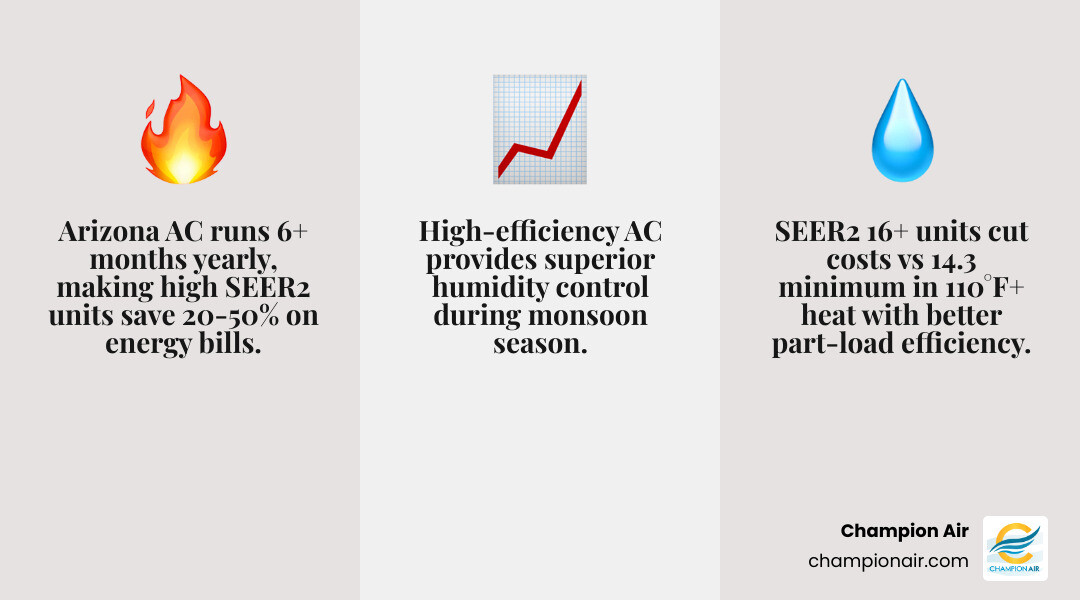
When comparing standard efficiency vs high efficiency ac for arizona, high-efficiency units (SEER2 16+) are almost always the better long-term choice for most Arizona homeowners — especially in Phoenix, Scottsdale, and Mesa, where your AC runs hard for six or more months a year.
Here's a quick comparison to help you decide:
| Factor | Standard Efficiency (SEER2 14.3) | High Efficiency (SEER2 16+) |
|---|---|---|
| Upfront cost | Lower | Higher |
| Monthly energy bills | Higher | Lower (up to 20-50% savings vs. older units) |
| Best for | Short-term ownership, tight budget | Long-term ownership, high cooling loads |
| Compressor type | Single-stage | Two-stage or variable-speed |
| Humidity control | Basic | Superior (important during monsoon season) |
| Federal tax credit eligible | Generally no | Yes (up to $600 under Section 25C) |
| Utility rebates (APS/SRP) | Typically no | Yes, for qualifying units |
| Performance at 115°F | Runs at full capacity | Also runs at full capacity, but more efficiently at lower loads |
| Recommended for Arizona | Meets minimum standard | Recommended for most homes |
Arizona is not a typical climate. Your AC isn't a seasonal appliance here — it's a machine that runs nearly nonstop from May through October, sometimes longer. At 110°F or above, the stakes of choosing the wrong system go beyond comfort. They hit your wallet every single month.
The good news: understanding the real differences between standard and high-efficiency systems — and knowing which one actually makes financial sense for your home — doesn't have to be complicated.
I'm Barry Farah, and I've spent years leading one of Arizona's largest residential HVAC replacement companies, helping thousands of homeowners across the Valley navigate exactly this decision around standard efficiency vs high efficiency ac for arizona. In this guide, I'll break down what the ratings actually mean, how Arizona's heat changes the math, and when upgrading is truly worth it.
Understanding Standard Efficiency vs High Efficiency AC for Arizona
When we talk about standard efficiency vs high efficiency ac for arizona, we have to start with the "alphabet soup" of industry ratings. As of May 2026, the industry has fully transitioned to the SEER2 (Seasonal Energy Efficiency Ratio 2) standard. This isn't just a name change; it’s a more rigorous testing protocol that accounts for the actual air pressure (static pressure) found in a typical home’s ductwork.
In the Southwest region, which includes our service areas like Scottsdale and Peoria, the Department of Energy mandates a federal minimum of 14.3 SEER2 for split-system air conditioners. Anything at this level is considered "standard efficiency." Once you cross into the 16 SEER2 to 20+ SEER2 range, you are entering high efficiency.
However, there is another metric we prioritize for our desert climate: EER2 (Energy Efficiency Ratio 2). While SEER2 is a weighted average of performance across a whole season, EER2 measures how efficiently the unit runs at a steady 95°F. In Phoenix, where we see 110°F+ for weeks on end, EER2 is often a better "diagnostic" of how the unit will handle a brutal July afternoon.
To dive deeper into these metrics, check out our guide on Everything to Know About SEER Ratings.
SEER2 Tiers and Energy Reduction
The jump in efficiency between tiers is often larger than homeowners realize. Because the math is based on ratios, a small numerical increase in SEER2 leads to significant electricity savings.
| SEER2 Rating | Efficiency Category | Approx. Energy Savings (vs. 14.3 SEER2) |
|---|---|---|
| 14.3 | Standard (Federal Minimum) | Baseline |
| 16.0 | High Efficiency (Mid-Tier) | ~10-12% |
| 18.0 | High Efficiency (Premium) | ~20-25% |
| 20.0+ | Ultra-High Efficiency | ~30%+ |
Performance Realities in 110°F+ Desert Heat
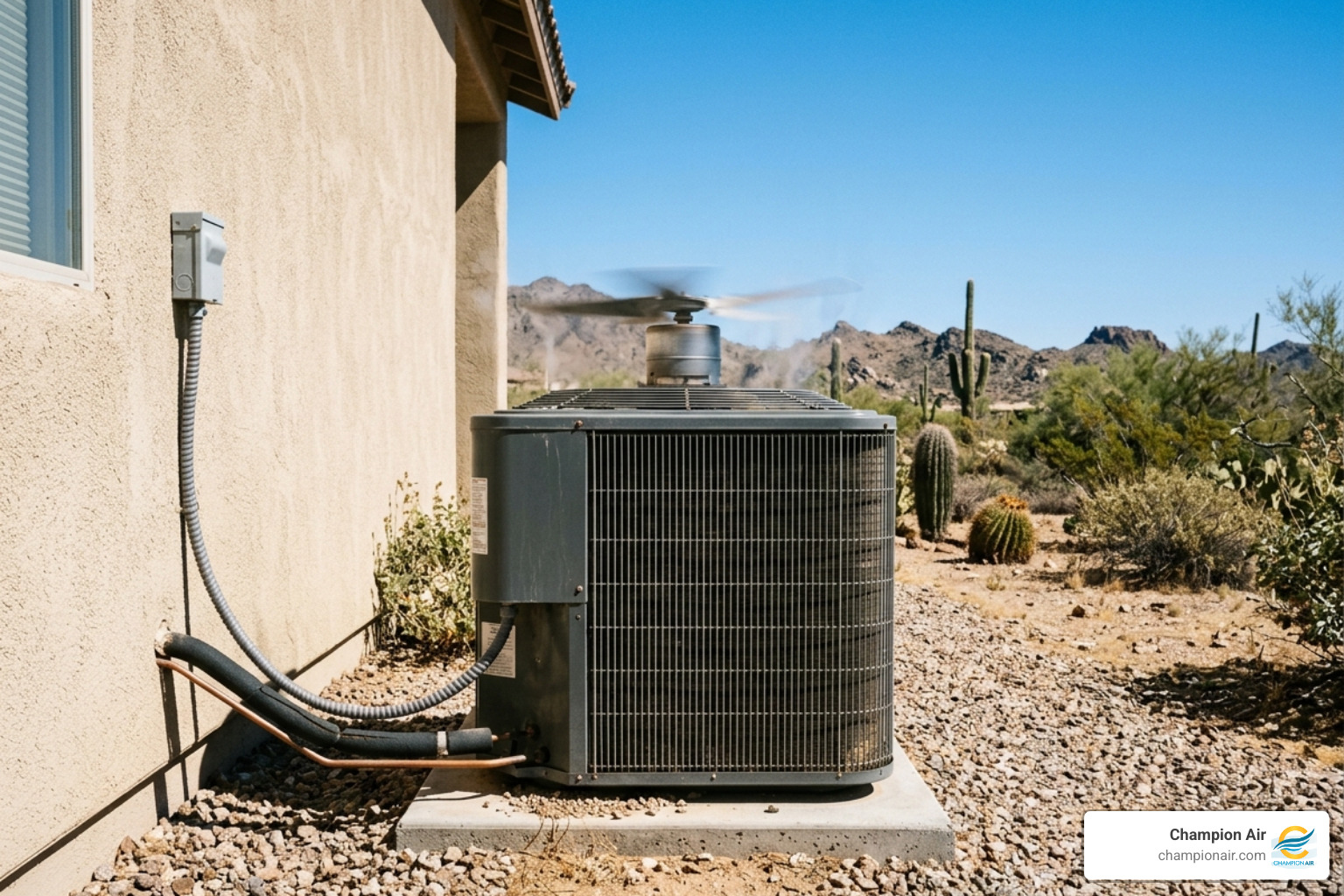
In many parts of the country, an AC unit is a luxury used for a few hours on a humid afternoon. In Arizona, it’s a life-support system. When the outdoor temperature hits 115°F, your attic can easily reach 140°F. This creates an environment of extreme thermal stress.
Standard efficiency units are built to meet the legal requirements, but they often struggle under the "peak load" conditions of a Phoenix summer. When a system is forced to run at 100% capacity for 12 hours straight, the components wear out faster. You can learn more about how our climate impacts equipment on our HVAC Efficiency page.
How Extreme Heat Impacts Standard Efficiency vs High Efficiency AC for Arizona
The primary difference in how these systems handle heat comes down to their "stamina." Standard efficiency units typically use single-stage compressors. These are either 100% on or 100% off. Imagine driving your car in Phoenix traffic by only using two settings: flooring the gas pedal or slamming on the brakes. It’s hard on the engine and uses a lot of fuel.
High-efficiency units, conversely, are designed for the long haul. Because they use more advanced compressors, they don't have to work as hard to maintain your indoor temperature. This reduced mechanical strain is a major factor in How Long Do Air Conditioners Last in Arizona? While a standard unit might start failing after 10-12 years of "flooring it," a high-efficiency system often enjoys a longer, more reliable lifespan.
The Role of Variable-Speed Technology in Desert Climates
The "secret sauce" of high-efficiency cooling is variable-speed (or inverter) technology. If a single-stage unit is a light switch, a variable-speed unit is a dimmer switch.
These systems can make hundreds of tiny adjustments to their speed, running at 40% capacity on a 90-degree morning and ramping up to 100% only when the afternoon sun hits the west-facing windows of your Surprise or Avondale home. This results in:
- Consistent Temperatures: No more 4-degree swings between cycles.
- Superior Dehumidification: This is critical during the Arizona monsoon season. Because variable-speed units run longer, lower-speed cycles, they pull significantly more moisture out of the air than a standard unit that "short-cycles."
- Quiet Operation: Since they rarely need to run at full blast, they are often whisper-quiet.
For a deeper look at this tech, see the Benefits of Variable Inverter Air Conditioner Technology.
Comparing System Features and Home Performance
Choosing between standard efficiency vs high efficiency ac for arizona also involves looking at your home's "envelope." A high-efficiency AC is only as good as the house it’s cooling.
If your home has leaky ductwork — which can account for up to 30% energy loss in older Mesa or Chandler homes — that 20 SEER2 unit won't be able to save you the money it promised. We always recommend a "whole-home" approach. This includes checking your attic insulation (aiming for R-38 to R-60 in the Valley) and ensuring your unit is properly sized. An oversized unit is just as bad as an undersized one because it will cool the house too fast, shut off, and leave the air feeling "cool but clammy."
If you aren't sure what size you need, our guide on What Size AC Unit Do I Need? provides a great starting point.
Standard Efficiency vs High Efficiency AC for Arizona: Central vs. Ductless
For some Arizona homes, the "best" efficiency doesn't come from a central unit at all. Ductless mini-split systems are inherently high-efficiency because they eliminate the energy loss associated with ductwork entirely.
They are perfect for:
- Room additions or converted garages.
- Older homes in historic Phoenix districts that lack space for ducts.
- Zoning specific rooms (like a home office) so you don't have to cool the whole house to 72°F just to work comfortably.
When deciding between these options, it's helpful to compare Choosing Air Conditioners vs. Heat Pumps to see which technology fits your lifestyle.
Maximizing Your Investment with Incentives and Maintenance
The biggest hurdle for high-efficiency systems is the initial investment. However, in 2026, there are more ways than ever to offset that cost.
Federal tax credits under the Inflation Reduction Act (Section 25C) allow homeowners to claim up to $600 for qualifying central AC units and even more for heat pumps. Additionally, local utility providers like APS and SRP often offer rebates ranging from $200 to $500 for systems that meet specific efficiency thresholds.
You can find a breakdown of these savings in our article on Federal IRA Tax Credits for HVAC Systems.
Maintenance and Home Improvements for Peak Efficiency
To keep a high-efficiency unit running at its rated SEER2, you have to treat it well. Arizona’s dust and monsoon haboobs are the enemies of efficiency.
- Change Filters Monthly: A dirty filter makes your high-efficiency motor work twice as hard.
- Duct Sealing: Ensure your conditioned air actually reaches your living room, not your attic.
- Smart Thermostats: These act as the "brain" of your system, helping you maximize How New HVAC Systems Save You Money by automating your cooling schedule.
Frequently Asked Questions about Arizona AC Efficiency
What is the minimum SEER2 rating for new AC units in Arizona?
As of 2023, the Department of Energy raised the minimum for the Southwest region to 14.3 SEER2 for split-system air conditioners. You cannot legally have a new system installed that falls below this rating in Arizona.
Does a higher SEER rating cool my house faster in 110-degree heat?
No. SEER measures efficiency (how much electricity is used), not cooling speed. The "speed" or power of the cooling is determined by the tonnage (BTUs) of the unit. A 3-ton standard unit and a 3-ton high-efficiency unit provide the same amount of cooling; the high-efficiency one just does it using less power.
Is it worth upgrading a 10-year-old standard unit to high efficiency?
Generally, yes. Modern high-efficiency units can use 20-50% less electricity than units from a decade ago. Given that cooling can account for over 50% of your summer electric bill in Arizona, the monthly savings often pay for the efficiency upgrade within a few years.
Conclusion: Finding the Sweet Spot for Your Home
When it comes to standard efficiency vs high efficiency ac for arizona, there is no one-size-fits-all answer, but there is a "sweet spot." For many of our neighbors in Scottsdale, Phoenix, and Mesa, a 16 to 18 SEER2 system offers the perfect balance of manageable upfront cost and significant long-term savings.
At Champion Air, we've lived through enough Arizona summers to know that reliability is just as important as efficiency. Whether you're in Anthem, Gilbert, or Buckeye, our team is here to perform a professional load calculation and help you choose a system that keeps you cool without breaking the bank.
Don't wait until the sidewalk starts melting to think about your AC's efficiency. Schedule your high-efficiency AC consultation today and let us help you find the perfect cooling solution for your Arizona home.
About the Author
Champion Air
More Articles
View All PostsKeep Reading
Related Articles


Ready to Get Started?
Whether you need a repair, maintenance, or a new installation, our expert team is here to help.