The Homeowner's Guide to Decoding SEER2 Ratings
Champion Air
Discover SEER2 ratings explained for homeowners: 2023 standards, Arizona efficiency rules, tax credits & savings tips. Upgrade smart!
The Homeowner's Guide to Decoding SEER2 Ratings
What Is a SEER2 Rating? A Plain-English Guide for Arizona Homeowners
SEER2 rating explained for homeowners in the simplest terms: it is the updated federal standard used since January 1, 2023, to measure how efficiently a central air conditioner or heat pump cools your home over an entire season. The higher the SEER2 number, the less electricity the system uses to deliver the same amount of cooling — and in Arizona's brutal summers, that difference shows up directly on your monthly utility bill.
Here is what you need to know at a glance:
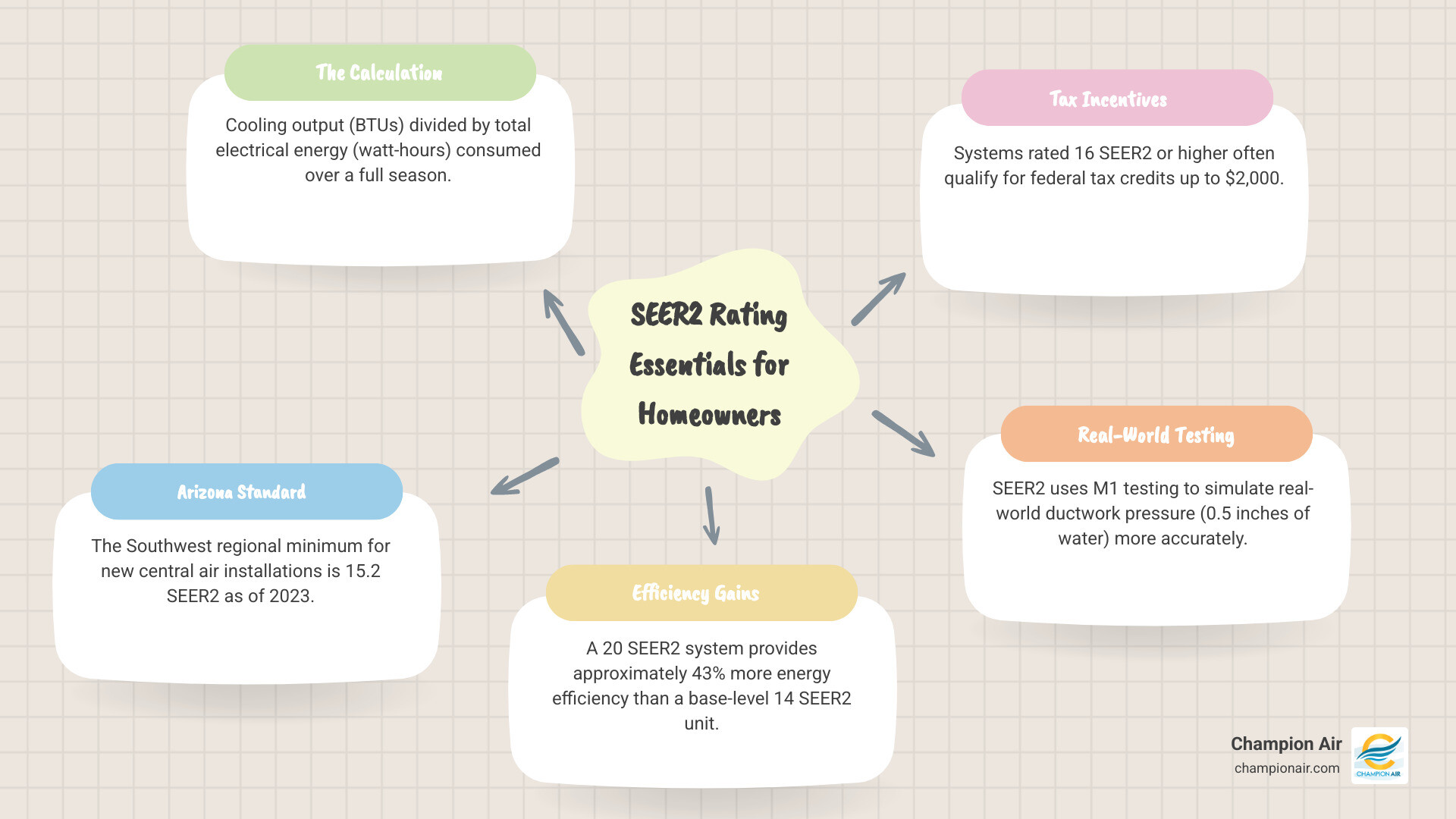
- SEER2 stands for Seasonal Energy Efficiency Ratio 2 — a measure of cooling output (in BTUs) divided by the total electrical energy consumed (in watt-hours) over a full cooling season
- Minimum SEER2 in Arizona is 15.2 for split-system central air conditioners (Southwest region standard)
- Minimum for heat pumps (nationwide) is 14.3 SEER2
- Tax credit threshold under the Inflation Reduction Act is SEER2 16 or higher for most split-system ACs
- Top-tier systems can reach up to 23.6 SEER2 using variable-speed compressor technology
- A 20 SEER2 unit is approximately 43% more energy efficient than a 14 SEER2 unit
- SEER2 numbers look slightly lower than old SEER numbers for the same equipment — that is normal and expected, not a sign of lower quality
If you have noticed your aging AC struggling to keep up with 110°F Phoenix summers, or your energy bills climbing higher every July, understanding your system's efficiency rating is the first step toward making a smarter upgrade decision. The jump from the old SEER standard to the new SEER2 standard in 2023 changed the numbers on every EnergyGuide label — and that shift has left a lot of Arizona homeowners confused about what they are actually looking at when comparing systems.
This guide cuts through that confusion. Whether you are replacing a failing unit, shopping for your first high-efficiency system, or simply trying to understand whether your current AC is still pulling its weight, the SEER2 rating is the single most important efficiency number to understand.
I'm Barry Farah, and as the leader of Arizona's largest Lennox family-owned residential HVAC replacement company, I have spent years helping homeowners navigate exactly this kind of decision — making seer2 rating explained for homeowners a topic I live and breathe every day in our desert climate. Let me walk you through everything you need to know to make a confident, informed choice for your home.
SEER vs. SEER2 Rating Explained for Homeowners: The 2023 Shift
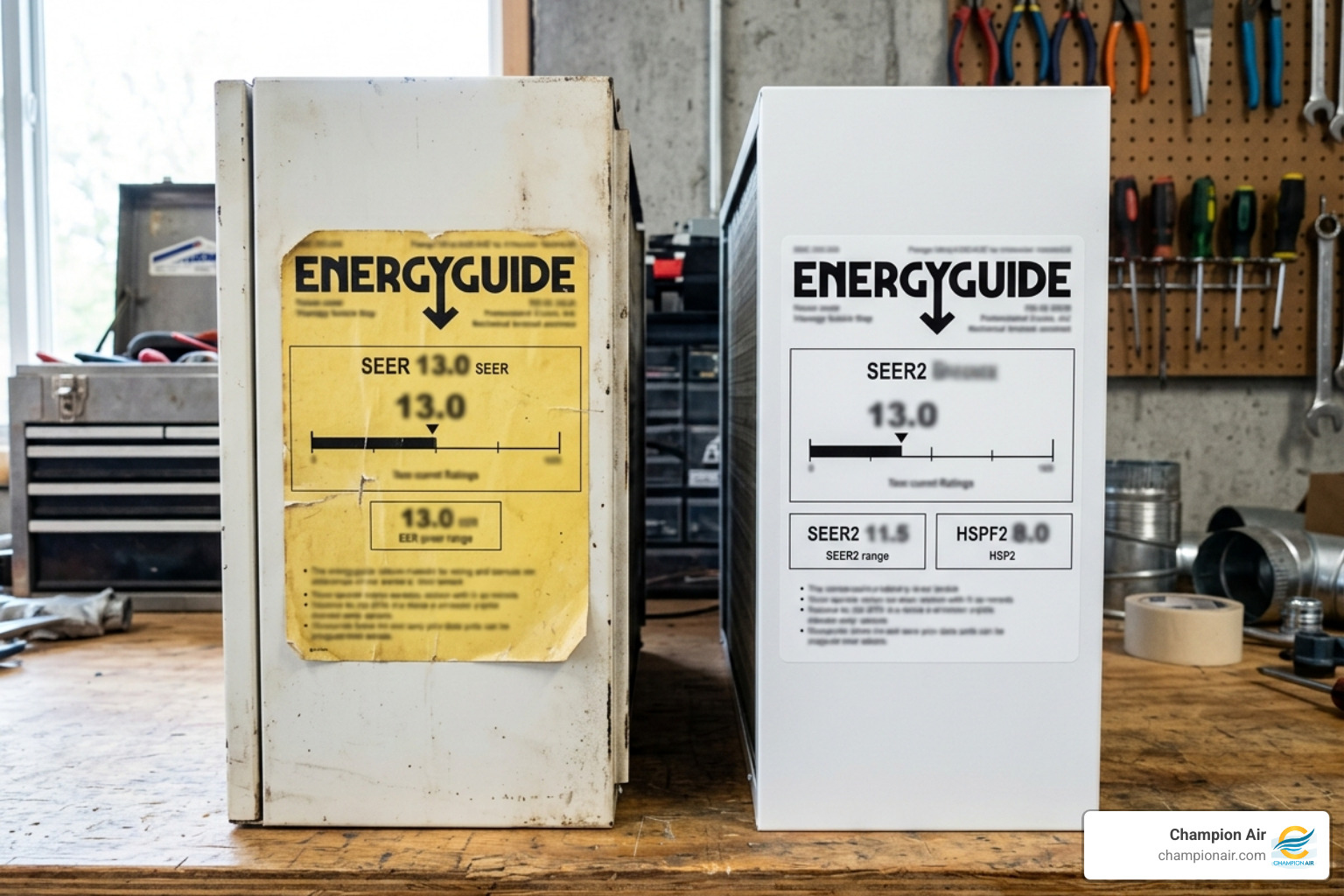
The move from SEER to SEER2 wasn't just a rebranding exercise; it was a fundamental change in how the Department of Energy (DOE) requires manufacturers to test equipment. For decades, the original SEER (Seasonal Energy Efficiency Ratio) was calculated in a laboratory environment that didn't always match the reality of a home in Scottsdale or Peoria.
The "old" way of testing assumed very little resistance to airflow. Think of it like testing a car's fuel efficiency on a perfectly flat, glass-smooth track with no wind. In the HVAC world, this resistance is called "external static pressure." The original SEER test used a static pressure of 0.1 inches of water column.
However, real homes have ductwork. They have air filters, twists, turns, and vents that create resistance. The new M1 testing procedure for SEER2 increases that external static pressure by a factor of five — from 0.1 to 0.5 inches of water. This change forces the system's blower motor to work harder during the test, much like it has to work in your actual attic or closet.
By increasing the "load" during the test, SEER2 provides a more "honest" rating. It tells us how the unit will actually perform when it’s pushing air through the ducts of a home in Surprise or Gilbert. To learn more about the basics of these metrics, check out our article on Everything to Know About SEER Ratings.
Why the numerical ratings look lower
One of the most common questions we hear at the kitchen table is: "Why does this new unit have a lower number than my old one if it’s supposed to be better?"
Because the SEER2 test is more rigorous, the resulting numerical rating is typically about 4.7% lower than the old SEER rating for the exact same piece of equipment. For example, a unit that was rated at 14 SEER under the old rules is now rated at approximately 13.4 SEER2.
It is vital for homeowners to understand that a lower SEER2 number does not mean a less efficient system. It simply means the "ruler" we use to measure efficiency has changed. If you are comparing a quote from 2022 with a quote from today, make sure you are comparing apples to apples.
Understanding EER2 and HSPF2
While SEER2 is the "headline" number, there are two other metrics you’ll see on the yellow EnergyGuide sticker: EER2 and HSPF2.
- EER2 (Energy Efficiency Ratio 2): While SEER2 measures efficiency over an entire season (averaging the highs and lows), EER2 measures efficiency at a specific, grueling temperature: 95°F. In the Valley of the Sun, where we regularly blow past 100°F, EER2 is arguably more important. It tells us how the unit performs during peak-day heat.
- HSPF2 (Heating Seasonal Performance Factor 2): This is the rating for heat pumps when they are in heating mode. Since we do have chilly desert nights in places like Cave Creek and Anthem, having a high HSPF2 ensures your winter electric bills stay low.
For a deeper dive into how these ratings impact your home's performance, visit our page on HVAC Efficiency.
Regional Minimums and the Southwest Standard
The Department of Energy doesn't treat the whole country the same. After all, a homeowner in Maine has very different cooling needs than someone in Mesa. The DOE divides the U.S. into three regions: North, Southeast, and Southwest.
Arizona falls squarely into the Southwest region. This is important because the Southwest has the strictest efficiency requirements in the nation for split-system central air conditioners. These regulations are not just suggestions; they are federal law. Manufacturers cannot sell, and contractors cannot legally install, equipment that falls below these regional minimums.
If you are deciding between different types of systems, our guide on Choosing Air Conditioners vs. Heat Pumps can help you navigate the regional requirements for each.
The 15.2 SEER2 requirement for Arizona
In the Southwest region, the minimum efficiency for a new split-system central air conditioner (the most common type of AC in Phoenix) is 15.2 SEER2.
This is a step up from the previous standards and often requires the use of more advanced components, such as Thermal Expansion Valves (TXVs), to manage refrigerant flow more precisely. These standards apply to all units with a cooling capacity of less than 45,000 BTU/h. For larger units, the requirements shift slightly, but the goal remains the same: reducing the massive strain that Arizona cooling puts on the electrical grid.
A SEER2 rating explained for homeowners in desert climates
In a climate where we experience over 1,500 annual cooling hours, the SEER2 rating is your best friend. When temperatures hit 115°F in Scottsdale, a low-efficiency unit won't just cost you more; it will struggle to maintain the "set point" on your thermostat.
High-efficiency SEER2 units are designed to handle extreme ambient temperatures. Many modern units are tested to operate effectively even when the outdoor air hitting the condenser is well above 110°F. If your current system is more than 10-12 years old, it was likely manufactured under a 10 or 13 SEER standard. Upgrading to a 15.2 or 18 SEER2 system can feel like moving from a flip phone to a smartphone in terms of technology and savings.
If you are wondering if your system is ready for the scrap heap, check out our list of Indicators It Is Time to Replace Your HVAC System.
Financial Incentives: Tax Credits and Savings
One of the best pieces of news for Arizona homeowners is that the transition to SEER2 coincided with the Inflation Reduction Act (IRA) of 2022. This federal law provides significant financial "carrots" to encourage you to choose a high-efficiency system rather than just the bare minimum.
The primary incentive is the 25C Tax Credit. This allows homeowners to deduct a portion of the cost of high-efficiency HVAC equipment directly from their federal income taxes.
Qualifying for rebates: A SEER2 rating explained for homeowners
To qualify for the most lucrative tax credits, you generally need to aim higher than the 15.2 SEER2 minimum.
- Central Air Conditioners: To qualify for a tax credit (up to $600), the system typically needs to meet or exceed 16 SEER2.
- Heat Pumps: This is where the real savings live. High-efficiency heat pumps can qualify for a tax credit of up to $2,000 per year.
In addition to federal tax credits, there are often state-level or utility-specific HVAC Rebates available. Depending on your income and location in cities like Tempe or Chandler, you might even qualify for point-of-sale rebates through state programs funded by the IRA. For a full breakdown, read our guide on Federal IRA Tax Credits for HVAC Systems.
Calculating your return on investment
Is a higher SEER2 rating worth the extra upfront cost? In Arizona, the answer is almost always "yes," but the "payback period" depends on how long you plan to stay in your home.
| System Rating | Efficiency vs. 14 SEER2 | Estimated Annual Savings (AZ) |
|---|---|---|
| 14.3 SEER2 | Baseline (Heat Pump) | $0 |
| 15.2 SEER2 | ~8% More Efficient | $100 - $150 |
| 18 SEER2 | ~20% More Efficient | $250 - $400 |
| 20+ SEER2 | ~43% More Efficient | $500+ |
Note: Estimates based on average Arizona usage of 1,500+ cooling hours. Actual savings vary by home size and electricity rates.
Upgrading from an old SEER 13 system to a modern SEER2 20 system can result in a reduction of about 1,800 kWh per year. That isn't just "pocket change"—it's a significant reduction in your carbon footprint and a massive relief for your wallet. See How New HVAC Systems Save You Money for more details on these calculations.
Maximizing Performance Through System Design
A high SEER2 rating is a promise of performance, but that promise is only kept if the system is designed and installed correctly. You could buy the most expensive 23 SEER2 unit on the market, but if it's connected to leaky ducts or sized incorrectly, it will perform like a 10 SEER unit.
This is why we insist on a Manual J Load Calculation. This isn't a "rule of thumb" based on square footage. It’s a scientific calculation that considers your home’s orientation to the sun, the number of windows, insulation levels in your attic, and even the height of your ceilings in places like Paradise Valley or Fountain Hills.
The role of proper installation and ductwork
Because SEER2 testing specifically accounts for static pressure, the quality of your ductwork is more important than ever. If your ducts are undersized or collapsed, a high-efficiency variable-speed motor will have to ramp up to its maximum speed just to get air into your rooms. This wastes electricity and can lead to a premature motor failure.
We also ensure that your system components are "matched." A SEER2 rating is achieved by the combination of the outdoor condenser and the indoor evaporator coil/air handler. If these aren't matched and verified in the AHRI (Air-Conditioning, Heating, and Refrigeration Institute) Directory, you won't get the efficiency you paid for.
Maintenance for long-term efficiency
Think of your high-efficiency AC like a high-performance sports car. It needs regular "oil changes" to stay at peak performance.
- Filter Changes: In the dusty Arizona desert, filters can clog fast. A dirty filter increases static pressure, forcing the system to work harder and lowering its effective SEER2.
- Coil Cleaning: If the outdoor coils are caked with dust and haboob silt, they can't shed heat efficiently.
- Professional Tune-ups: Annual maintenance ensures your refrigerant levels are perfect. Even a 10% undercharge can tank your efficiency by 20%.
Frequently Asked Questions about SEER2
How do I find the SEER2 rating of my current unit?
The easiest way is to look for the yellow EnergyGuide sticker on the side of your outdoor unit. If that sticker has "grown legs" and disappeared over the years, don't worry. You can find the model number on the manufacturer's data plate (usually a silver or black metal tag). A quick search of that model number online, or a call to us, can reveal the original rating. That if your unit was installed before 2023, it will have a SEER rating, not a SEER2 rating.
Is a higher SEER2 rating always better for every home?
While higher is better for the environment and your monthly bill, it’s a balance of upfront cost vs. long-term savings. If you plan on moving out of your home in two years, you might not recoup the investment of a 22 SEER2 system. However, for "forever homes" in Arizona, the comfort benefits of variable-speed technology (which usually comes with higher SEER2 ratings) are often worth it regardless of the payback period.
Does a higher SEER2 rating mean a quieter air conditioner?
Generally, yes. High-efficiency units often use variable-speed compressors and fans. Instead of slamming "on" at 100% power (which creates that loud thump and whir), these systems start softly and run at lower speeds for longer periods. Many high-SEER2 units operate in the 64-76 dB(A) range—about the volume of a normal conversation—compared to older units that can sound like a jet engine taking off in your side yard.
Conclusion
Understanding the seer2 rating explained for homeowners is about more than just knowing a number—it’s about taking control of your home’s comfort and your financial future. In the intense heat of the Phoenix Valley, your air conditioner is your home's most important appliance. Choosing a system with the right SEER2 rating ensures you aren't just surviving the summer, but doing so efficiently and affordably.
At Champion Air, we specialize in helping homeowners in Scottsdale, Phoenix, Mesa, and throughout the Valley find the perfect balance of efficiency and value. Whether you are in Sun City, Queen Creek, or Avondale, our licensed technicians are ready to provide expert guidance, 24/7 emergency support, and customized cooling solutions tailored to our unique desert climate.
Don't let another record-breaking summer catch you off guard with an inefficient system. Schedule your high-efficiency AC installation with Champion Air today and start enjoying the peace of mind that comes with a cooler home and lower energy bills.
About the Author
Champion Air
More Articles
View All PostsKeep Reading
Related Articles


Ready to Get Started?
Whether you need a repair, maintenance, or a new installation, our expert team is here to help.