Why Your Heat Pump is Acting Up and How to Fix It
Champion Air
Discover most common heat pump repairs and what causes them. Fix freezing, cold air, noises & more in Arizona heat with expert tips!
Why Your Heat Pump is Acting Up and How to Fix It
Why Knowing the Most Common Heat Pump Repairs and What Causes Them Can Save You Money
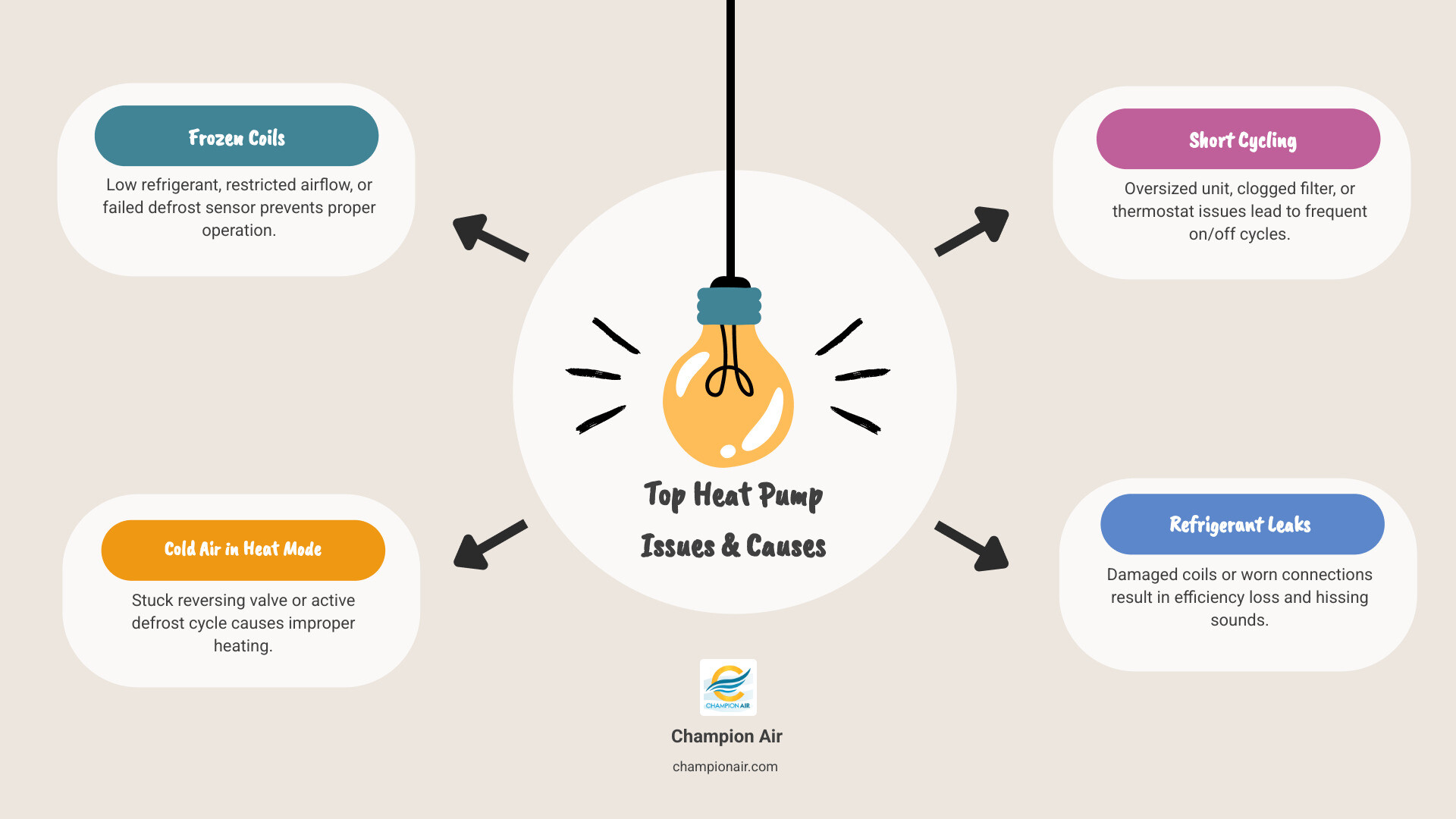
The most common heat pump repairs and what causes them include the following issues that Arizona homeowners run into most often:
| Repair Issue | Common Cause |
|---|---|
| Frozen or iced-over coils | Low refrigerant, restricted airflow, or a failed defrost sensor |
| Blowing cold air in heating mode | Stuck reversing valve or active defrost cycle |
| Short cycling (turns on and off repeatedly) | Oversized unit, clogged filter, or thermostat problems |
| System not reaching set temperature | Extreme outdoor heat, ductwork leaks, or a struggling compressor |
| Unusual noises (grinding, rattling, clicking) | Worn motor bearings, loose panels, or a failing capacitor |
| Refrigerant leak | Damaged coils or worn line connections |
| Tripped circuit breaker | Failing compressor, shorted fan motor, or dirty condenser coils |
| Weak or no airflow | Clogged air filter or blower motor failure |
Your heat pump works harder than almost any other system in your home. In Arizona, that's not a figure of speech — it runs through scorching summers, mild winters, and dusty monsoon seasons without a break. Nearly 30% of heat pump owners report that their system isn't heating or cooling well enough, making insufficient performance the single most reported problem. And a neglected system can use up to 25% more energy just to deliver the same results as a well-maintained one.
Think of diagnosing a heat pump problem the way you'd think about a strange noise your car makes or the way it pulls to one side. You don't need to be a mechanic to notice something is off — but understanding what the symptom likely means helps you know what to expect before a technician shows up. That's exactly what this guide is designed to do.
I'm Barry Farah, and alongside my son I lead one of Arizona's largest residential HVAC companies, where we've helped thousands of homeowners navigate the most common heat pump repairs and what causes them across the Phoenix metro area. Understanding these issues from the inside out is what drives how we train our team and serve our customers every day.
Identifying the most common heat pump repairs and what causes them

In the Valley of the Sun, our heat pumps are the marathon runners of the HVAC world. Because they provide both cooling in the summer and heating in the winter, they rarely get a "day off." This constant operation means that wear and tear happen faster here than in milder climates. When we visit homes for Heat Pump Repair Phoenix AZ, we often find that the root cause of a breakdown is something that started small—like a layer of dust or a slightly miscalibrated thermostat.
Arizona dust is a silent system killer. It settles on your outdoor coils, acting as an insulating blanket that prevents heat exchange. This forces your compressor to work 20% to 30% harder, leading to premature mechanical failure. Many of the service calls we receive could have been prevented with regular Heat Pump Maintenance Scottsdale AZ, which keeps those coils clean and ensures the thermostat is communicating correctly with the unit.
What causes a heat pump to freeze up or ice over?
It seems backward to see ice on an HVAC unit when it’s 45 degrees outside in Mesa, but it happens more often than you’d think. A frozen coil is usually a cry for help regarding airflow or refrigerant. If air can't move across the coils—perhaps due to a filthy filter or a failing blower motor—the moisture on the coils freezes.
Another major culprit is a failure in the defrost cycle. Heat pumps are designed to occasionally switch into a temporary "cooling mode" to send heat to the outdoor coils and melt frost. If the defrost control board or the outdoor temperature sensor fails, that ice will just keep building up until the unit is encased. If you notice a block of ice, it’s time to call for Heat Pump Repair Mesa AZ before the weight of the ice damages the fan blades or the compressor.
Why is my heat pump blowing cold air in heating mode?
If you have your thermostat set to heat but feel a chilly breeze, don't panic—it might be normal, or it might be a mechanical glitch. First, check if the system is in "defrost mode." During this cycle, the unit briefly blows cold air inside while it melts ice outside. This should only last a few minutes.
However, if the cold air is constant, you likely have a reversing valve failure. This valve is the "brain" that tells the refrigerant which way to flow. If it gets stuck or the solenoid coil that powers it fails, the system might get trapped in cooling mode. This is one of the most common heat pump repairs and what causes them often involves electrical shorts or physical blockages within the valve itself. For homeowners needing Heat Pump Repair Chandler AZ, a stuck valve is a high-priority fix to restore comfort.
Mechanical and Electrical Component Failures
The electrical heart of your heat pump is sensitive to the extreme temperatures we face in Scottsdale and Gilbert. High heat increases electrical resistance, which puts a massive strain on components like capacitors and contactors. Think of a capacitor like a giant battery that gives your motors the "kick" they need to start. In May 2026, as we look back at the previous summer's data, we see that electrical failures remain a leading cause of emergency calls.
Pitted contactors—the switches that close to send power to the compressor—can also cause issues. When these become charred or "pitted" from years of use, they can stick together, causing the outdoor unit to run non-stop, or they may fail to connect at all. We frequently see these issues during Heat Pump Repair Scottsdale AZ, where the combination of heat and monsoon-driven dust creates a perfect storm for electrical corrosion. If you're in the East Valley, Heat Pump Repair Gilbert AZ often involves replacing these small but vital parts before they cause a more expensive motor burnout.
Signs of a failing capacitor or reversing valve
How do you know if your capacitor is on its last legs? Listen for a humming sound coming from the outdoor unit followed by a "click," but the fan or compressor never actually starts. This is called "hard starting." It’s like a car engine trying to turn over with a weak battery.
As for the reversing valve, the biggest sign is a "limp mode" where the system only provides one temperature regardless of the thermostat setting. You might also hear a distinct "whooshing" sound if the valve is leaking internally. If you hear these noises, reaching out for Heat Pump Repair Glendale AZ quickly can prevent the compressor from overheating while trying to push refrigerant through a faulty valve.
What causes a heat pump to short cycle in the Arizona heat?
Short cycling—when your heat pump turns on and off every few minutes—is incredibly hard on your equipment. In the West Valley, we often find this is caused by an oversized system. If a unit is too powerful for the home, it cools the air so quickly that the thermostat shuts it off before it can properly dehumidify or stabilize the temperature.
Other causes include a thermostat placed too close to a supply vent (tricking it into thinking the room is cooler than it is) or severely clogged air filters. When we perform Heat Pump Repair Surprise AZ, we often remind homeowners that short cycling isn't just annoying; it’s the fastest way to kill a compressor. It’s also one of the most common heat pump repairs and what causes them is frequently tied to restricted airflow or low refrigerant levels causing a safety switch to trip.
Troubleshooting Unusual Noises and Performance Drops
Your heat pump should generally operate with a steady hum. When it starts sounding like a bag of marbles in a dryer, it’s trying to tell you something.
| Sound | Potential Issue | Severity |
|---|---|---|
| Grinding | Failing motor bearings | High - Requires immediate shutoff |
| Rattling | Loose panels or debris in the fan | Low to Medium - Tighten screws or clear debris |
| Screeching | Worn blower belt or motor issues | Medium - Needs professional adjustment |
| Clicking | Failing capacitor or electrical relay | Medium - System may fail to start soon |
| Hissing | Refrigerant leak | High - Environmental and performance hazard |
If you hear a high-pitched screeching or grinding, it’s often a sign that the bearings in your fan motor are failing. For residents needing Heat Pump Repair Peoria AZ, addressing these sounds early can be the difference between a simple motor lubrication and a total motor replacement. Similarly, if you're experiencing rattling in the East Valley, Heat Pump Repair Tempe AZ might just involve securing loose housing panels that have vibrated over time.
How to identify a refrigerant leak in your system
Refrigerant is the lifeblood of your heat pump. Unlike gas in a car, refrigerant isn't "used up"—it circulates in a closed loop. If your levels are low, you have a leak. Common signs include a noticeable drop in cooling capacity, hissing sounds near the line sets, or oily residue on the coils.
When we investigate the most common heat pump repairs and what causes them during a Heat Pump Repair Scottsdale AZ visit, we often find that small vibrations have caused the copper lines to rub together, creating a pinhole leak. You might also see frost on the indoor evaporator coil even in the middle of summer. If you suspect a leak, call for Heat Pump Repair Goodyear AZ immediately. Adding more refrigerant without fixing the leak is illegal and will eventually destroy your compressor.
Why is my heat pump running constantly without reaching the temperature?
When the Arizona mercury hits 115 degrees, almost every heat pump will run for long stretches. However, if it’s a relatively mild 90-degree day and your system won't stop, something is wrong. This is often caused by undersized units that simply can't keep up with the home's heat load, or leaky ductwork that is dumping your expensive cold air into the attic.
In Buckeye, where many homes have expansive duct systems, a single disconnected duct can cause a 30% loss in efficiency. We recommend Heat Pump Repair Buckeye AZ to inspect for these leaks. Combined with Heat Pump Maintenance Mesa AZ, ensuring your system is sized correctly and your ducts are sealed is the best way to stop that constant, wallet-draining operation.
When to Repair vs. Replace Your Arizona Heat Pump
Eventually, every heat pump reaches the end of its road. Most systems in Arizona last between 12 and 15 years. If your unit is pushing that age and you’re facing a major repair—like a failed compressor or a leaking coil—it’s time to look at the "50% Rule." If the cost of the repair is more than 50% of the value of a new system, replacement is usually the smarter financial move.
Newer Heat Pumps are significantly more efficient than those manufactured just a decade ago, often paying for themselves in energy savings over a few years. If you're constantly calling for Heat Pump Repair Fountain Hills AZ, it might be more cost-effective to upgrade to a modern, high-efficiency unit with a fresh warranty. For more details on system longevity, check out our guide on How Long Do Heat Pumps Last.
Frequently Asked Questions about Heat Pump Issues
What electrical issues cause a heat pump to trip the circuit breaker?
A tripped breaker is a safety feature, not just a nuisance. If your heat pump trips the breaker once, it might be a power surge. But if it happens repeatedly, you likely have a "grounded" compressor (where the internal wiring has shorted to the casing) or a fan motor that is drawing too much current due to friction. Dirty condenser coils can also cause the system to overheat and pull excess electricity. If you're in Sun City, Heat Pump Repair Sun City AZ can help diagnose whether the issue is with the HVAC unit or the breaker itself.
How does a clogged air filter lead to major mechanical failures?
It’s hard to believe a $20 filter can cause a $3,000 repair, but it happens every day. A clogged filter restricts airflow, which causes the evaporator coil to get too cold and freeze. This ice can then "slug" the compressor—meaning liquid refrigerant enters the compressor instead of gas—which can lead to instant mechanical failure. It also forces the blower motor to work at high pressure, leading to overheating and burnout.
What maintenance steps can homeowners take to prevent repairs?
The best thing you can do is change your air filters every 30 to 90 days—more often if you have pets or during monsoon season. Second, keep the area around your outdoor unit clear. We recommend at least two feet of clearance from plants, debris, and "desert landscaping" rocks. Finally, don't close off too many indoor vents; your system needs to breathe to maintain proper pressure. For professional help, our Heat Pump Maintenance Scottsdale AZ plans take the guesswork out of keeping your system healthy.
Conclusion
At Champion Air, we know that a broken heat pump in the middle of a Phoenix summer is more than an inconvenience—it’s an emergency. Whether you're dealing with a mysterious clicking sound, a frozen coil, or a system that just won't keep up, our team of licensed technicians is ready to help. We specialize in Arizona’s unique climate challenges, offering 24/7 emergency service with no overtime charges to ensure your family stays comfortable year-round. From Scottsdale to Buckeye and everywhere in between, we provide the expert diagnostics and reliable repairs you need to keep your home running efficiently. If your system is acting up, don't wait for a total breakdown—reach out to us today to learn more about our Heat Pumps and professional repair services.
About the Author
Champion Air
More Articles
View All PostsKeep Reading
Related Articles


Ready to Get Started?
Whether you need a repair, maintenance, or a new installation, our expert team is here to help.