Why Your Wallet Might Love a Variable Speed AC Upgrade
Champion Air
Find out is a variable speed ac worth the extra cost for your home. Save on energy and boost comfort in the Arizona heat.
Why Your Wallet Might Love a Variable Speed AC Upgrade
Is a Variable Speed AC Worth the Extra Cost? Here's What Arizona Homeowners Need to Know
Is a variable speed ac worth the extra cost? For most Arizona homeowners dealing with brutal summer heat, the answer is yes — and the gap in comfort, efficiency, and long-term savings compared to a standard single-stage unit is significant.
Quick answer based on your situation:
| Your Situation | Worth It? |
|---|---|
| You live in Phoenix, Scottsdale, or Mesa with long, hot summers | Yes — high cooling demand means faster payback |
| You want consistent temperatures and lower humidity indoors | Yes — variable speed holds temps within 0.5°F |
| You plan to stay in your home 5+ years | Yes — energy savings compound over time |
| You have allergy or air quality concerns | Yes — longer run cycles filter more air |
| You live in a mild climate with short cooling seasons | Maybe not — savings may take longer to recover |
| You're on a tight budget and may move soon | A two-stage system may be a better fit |
Here's the core issue: standard single-stage air conditioners blast on at full power, cool the air quickly, then shut off — over and over, all day long. That constant start-stop cycle burns energy, wears out parts faster, and leaves your home with uneven temperatures and stuffy air. Variable speed systems work differently. They run almost continuously at a low, steady pace — adjusting output in small increments to match exactly what your home needs at any given moment. Think of it like the difference between flooring the gas pedal and coasting at a smooth, steady speed on the highway.
According to the U.S. Department of Energy, variable speed systems use about 25% less energy than standard systems delivering the same amount of cooling. In a warm climate like Arizona's, where your AC runs hard for six or more months a year, that efficiency gap translates into real, recurring savings.
But energy bills are only part of the story. Comfort, humidity control, noise, air quality, and how long your system lasts all factor into whether the upgrade makes financial sense for your home.
I'm Barry Farah, and as the leader of Arizona's largest Lennox family-owned residential HVAC replacement company, I've spent years helping homeowners across Scottsdale, Phoenix, and Mesa navigate exactly this question — is a variable speed ac worth the extra cost — and the answer almost always comes down to your specific home, climate demands, and long-term goals. Let's walk through everything you need to make a confident, informed decision.
Defining the Technology: Single-Stage vs. Variable Speed
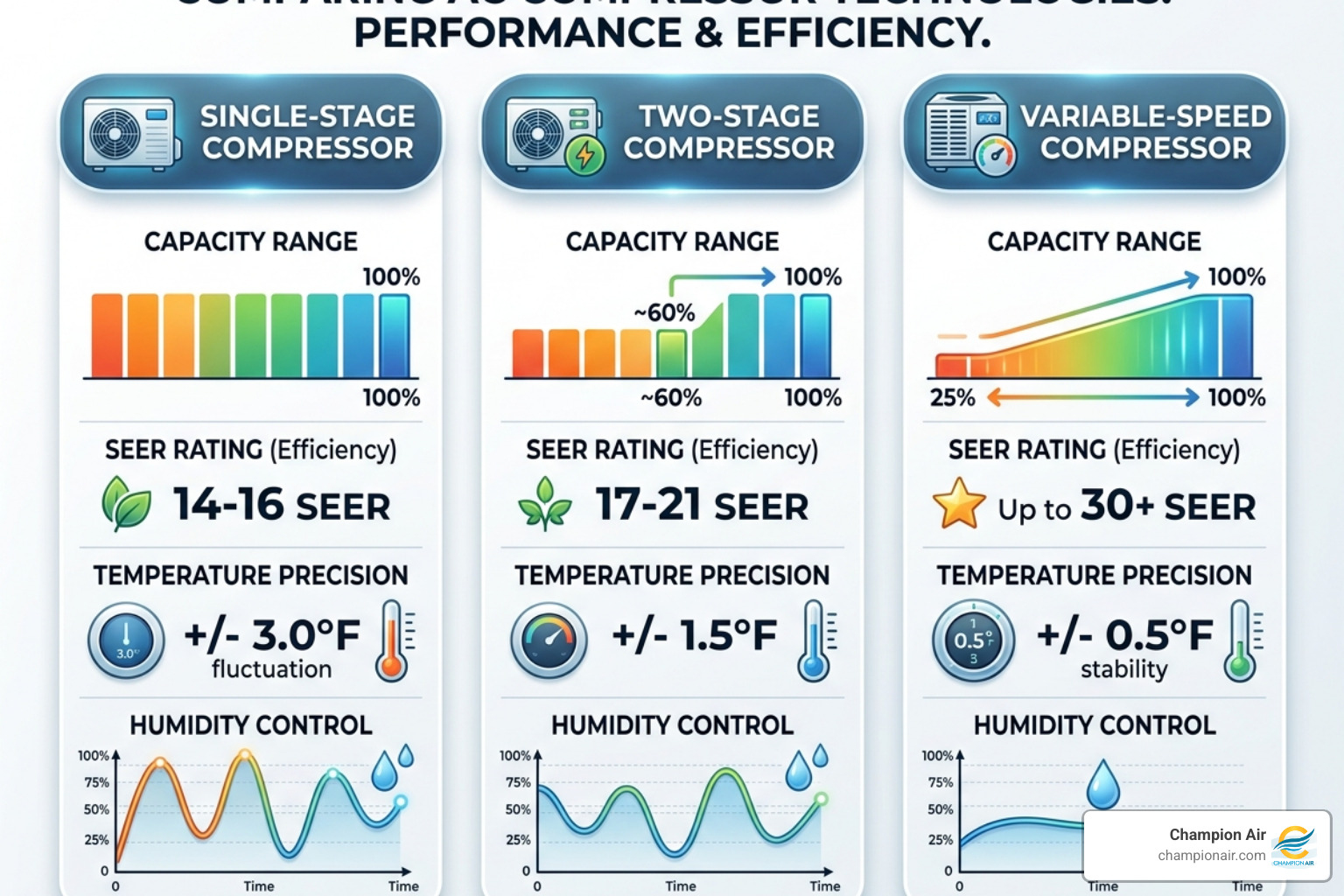
To understand if the investment is right for you, we first need to look under the hood. Most homes in Phoenix and Scottsdale currently use single-stage technology. This is essentially a "binary" system: it is either 100% on or 100% off. When your thermostat detects the temperature has risen, the compressor kicks on at full blast until the target is reached, then shuts down.
Variable speed technology, also known as modulating or inverter technology, is the "dimmer switch" of the HVAC world. Instead of just two settings, these compressors can operate at hundreds of different speeds. Many systems can modulate their output in increments as small as 1/10th of 1%, ranging anywhere from 25% to 100% capacity.
By utilizing Benefits of Variable Inverter Air Conditioner Technology, the system calculates exactly how much cooling is needed to offset the heat entering your home. On a relatively mild May morning in Mesa, the unit might hum along at 30% capacity. As the afternoon sun hits 110°F, it seamlessly ramps up to 100%. This fluid movement is what makes Air Conditioners with variable speed compressors so much more advanced than their predecessors.
How variable speed AC provides value through energy efficiency
The most common reason people ask if is a variable speed ac worth the extra cost is the promise of lower utility bills. In the HVAC industry, we measure this efficiency using SEER2 (Seasonal Energy Efficiency Ratio) ratings. While standard single-stage units often land between 13 and 16 SEER2, variable speed systems frequently reach ratings of 18 to 28.
Upgrading from a 14 SEER single-speed system to a 21 SEER variable speed system can reduce your cooling energy consumption by approximately 33%. This happens because the system avoids the "startup spike." It takes significantly more electricity to start a motor from a dead stop than it does to keep it running at a low speed. Because variable speed units stay on for longer cycles at lower power levels, they bypass the most expensive part of the cooling process. For a typical 2,000-square-foot home in the Phoenix Valley, this can equate to hundreds of dollars in savings every year on Air Conditioning costs.
Operational noise and decibel levels
If you’ve ever had to pause a conversation or turn up the TV because the AC kicked on, you’ll appreciate the quiet nature of variable speed units. Because they ramp up and down gradually, you don't get that jarring "thump" of a compressor starting at full tilt.
Standard units typically operate at 70–75 decibels—roughly the volume of a vacuum cleaner. In contrast, premium variable speed units often run in the mid-50s decibels. At low speeds, these units are so quiet you might not even realize they are running. This is achieved through sound-dampening insulation and advanced fan blade designs that slice through the air with minimal turbulence.
Is a variable speed AC worth the extra cost for Arizona homeowners?
In Arizona, our cooling season isn't just a few weeks in July; it’s a marathon that lasts from April through October. This high "cooling load" makes the ROI for high-efficiency systems much more attractive here than in cooler states.
| Feature | Single-Stage | Two-Stage | Variable-Speed |
|---|---|---|---|
| Capacity | 100% only | ~65% or 100% | 25% to 100% |
| Temp Swing | 3°F to 5°F | 1°F to 2°F | Within 0.5°F |
| Humidity Removal | Standard | Better | Superior |
| Sound Level | Loudest | Moderate | Quietest |
| Efficiency (SEER2) | 13–15 | 16–18 | 18–28 |
Why variable speed AC offers superior comfort
Consistency is the hallmark of luxury in home comfort. Single-stage systems create a "yo-yo" effect. You feel a blast of cold air, then as the system sits idle, the room warms up, the air gets stagnant, and the cycle repeats. This leads to temperature swings of 3 to 5 degrees.
Variable speed systems maintain your home within 0.5°F of your thermostat setting. By providing a constant, gentle stream of air, they eliminate those annoying "hot spots" in rooms further from the air handler. This steady circulation ensures that the air in your Scottsdale home stays moving, preventing that "heavy" or "stuffy" feeling that often occurs between cycles in older systems.
Long-term ROI and energy savings
When evaluating if the upgrade is worth it, we look at the "break-even" point. While the upfront investment for a variable speed system is higher, the monthly savings are consistent. Most homeowners in our service area see a reduction of 25% to 40% in their monthly cooling costs.
Beyond the monthly bill, there is the factor of system longevity. The most mechanical stress an AC compressor faces is during the startup sequence. Because variable speed units have "soft starts" and cycle on and off much less frequently, they experience less wear and tear. A well-maintained variable speed system can last 15 to 20 years, whereas a single-stage unit pushed to its limits in the Phoenix heat might only see 10 to 12 years of reliable service. When you spread the total cost over a longer lifespan, the value proposition becomes even clearer.
Impact on Indoor Air Quality and Humidity Control
While Arizona is famous for "dry heat," we still face humidity challenges during the monsoon season. More importantly, indoor air quality is a major concern for many families in our desert environment.
Extended run cycles and filtration
Your air conditioner only filters the air when it is running. Since single-stage units turn off as soon as the temperature drop is achieved, the air sits still for long periods. Variable speed systems run for much longer cycles at lower speeds. This means your air is being pulled through your high-efficiency filters almost continuously.
Studies have shown that these longer cycles can allow filters to catch up to 40% more dust, pollen, and allergens. For families in Peoria or Gilbert who suffer from seasonal allergies or dust sensitivity, this improved filtration is often the deciding factor in their upgrade. Furthermore, because the air moves slower through the evaporator coil, the system is much more effective at removing moisture. Even in our dry climate, keeping humidity between 30% and 50% is essential for preventing mold growth and keeping your skin and furniture from drying out.
Technical Requirements and System Longevity
Upgrading to a variable speed system isn't just about swapping out the outdoor box. These are sophisticated machines that require a specific environment to perform at their peak.
Ductwork compatibility and professional load calculations
One of the most critical steps we take at Champion Air before an installation is a professional load calculation (often called a Manual J). Over 60% of U.S. homes have HVAC sizing errors. If a variable speed unit is oversized, it will never reach its low-speed, high-efficiency state.
Your ductwork also needs to be up to the task. Variable speed systems are sensitive to "static pressure." If your ducts are too small, leaky, or uninsulated, you could lose 25% to 40% of your airflow. In fact, uninsulated metal ducts can be a deal-breaker. Because variable speed units run long cycles that keep ducts very cold, uninsulated metal can "sweat" or develop condensation, which can lead to water damage or mold inside your walls. Our technicians always inspect your infrastructure to ensure your home is a good candidate for this technology.
Maintenance and repair considerations
It is a common myth that variable speed systems are "fragile." In reality, they are built with high-end components designed for durability. However, because they use specialized inverter boards and communicating sensors, repairs can be more complex than on a basic single-stage unit.
This makes regular maintenance non-negotiable. Annual tune-ups ensure the electronics stay cool and the sensors stay calibrated. While the parts are specialized, the reduced mechanical stress on the compressor often leads to fewer major mechanical failures over the system's life.
Frequently Asked Questions about Variable Speed Upgrades
Does a variable speed AC require a specific thermostat?
Yes. To unlock the full potential of a variable speed system, you typically need a "communicating" thermostat designed by the manufacturer. While some "bridge" kits allow for the use of standard smart thermostats, they often limit the system to just a few speeds rather than the full range of modulation. A communicating thermostat acts as the "brain," talking back and forth with the compressor and air handler to optimize performance every second.
Is my existing ductwork compatible with a variable speed system?
In many cases, yes, but it requires a professional evaluation. We look for proper sizing to handle the variable airflow and ensure there is adequate insulation. If your home has bare metal ducts hidden in the walls, we may need to address that before recommending a variable speed upgrade to prevent condensation issues.
How long do variable speed HVAC systems typically last?
With proper maintenance, a variable speed system can last 15 to 20 years. The primary reason for this extended lifespan is the "soft start" technology. By avoiding the violent, high-amp draw of a traditional startup, the electrical and mechanical components stay in much better condition over time.
Conclusion
So, is a variable speed ac worth the extra cost? For the majority of homeowners in Scottsdale, Phoenix, and Mesa, the answer is a resounding yes. The combination of extreme summer heat and the long cooling season creates the perfect scenario where energy savings, superior comfort, and improved air quality quickly offset the initial investment.
At Champion Air, we believe in providing solutions tailored to the unique demands of the Arizona climate. Whether you are in Surprise, Chandler, or Paradise Valley, our team of licensed experts is ready to help you evaluate your home's needs. We specialize in high-efficiency replacements and offer 24/7 emergency service with no overtime charges, ensuring your family stays comfortable no matter how high the temperature climbs.
Ready to see how much you could save with a variable speed upgrade? Contact us today for a comprehensive home comfort evaluation and let us help you find the perfect system for your lifestyle and your wallet.
About the Author
Champion Air
More Articles
View All PostsKeep Reading
Related Articles


Ready to Get Started?
Whether you need a repair, maintenance, or a new installation, our expert team is here to help.