Beat the Heat: Things to Do Before the Extreme Heat Hits
Champion Air
Learn how to make sure your ac survives an arizona summer: maintenance tips, shading, smart cooling & monsoon prep for Phoenix heat!
Beat the Heat: Things to Do Before the Extreme Heat Hits
Why Arizona Summers Are the Ultimate Test for Your AC System
How to make sure your AC survives an Arizona summer comes down to a handful of critical steps every homeowner should take before the heat peaks:
- Schedule a professional AC tune-up before May — check refrigerant levels, capacitors, and electrical connections
- Change your air filter every 30–45 days during summer, not the standard 3 months
- Set your thermostat to 78°F when home and 82–85°F when away
- Clear at least 2 feet of space around your outdoor condenser unit
- Seal and insulate your ductwork to prevent cooling loss in your attic
- Install solar screens or window film on south- and west-facing windows
- Protect your system from monsoon damage with surge protection and post-storm inspections
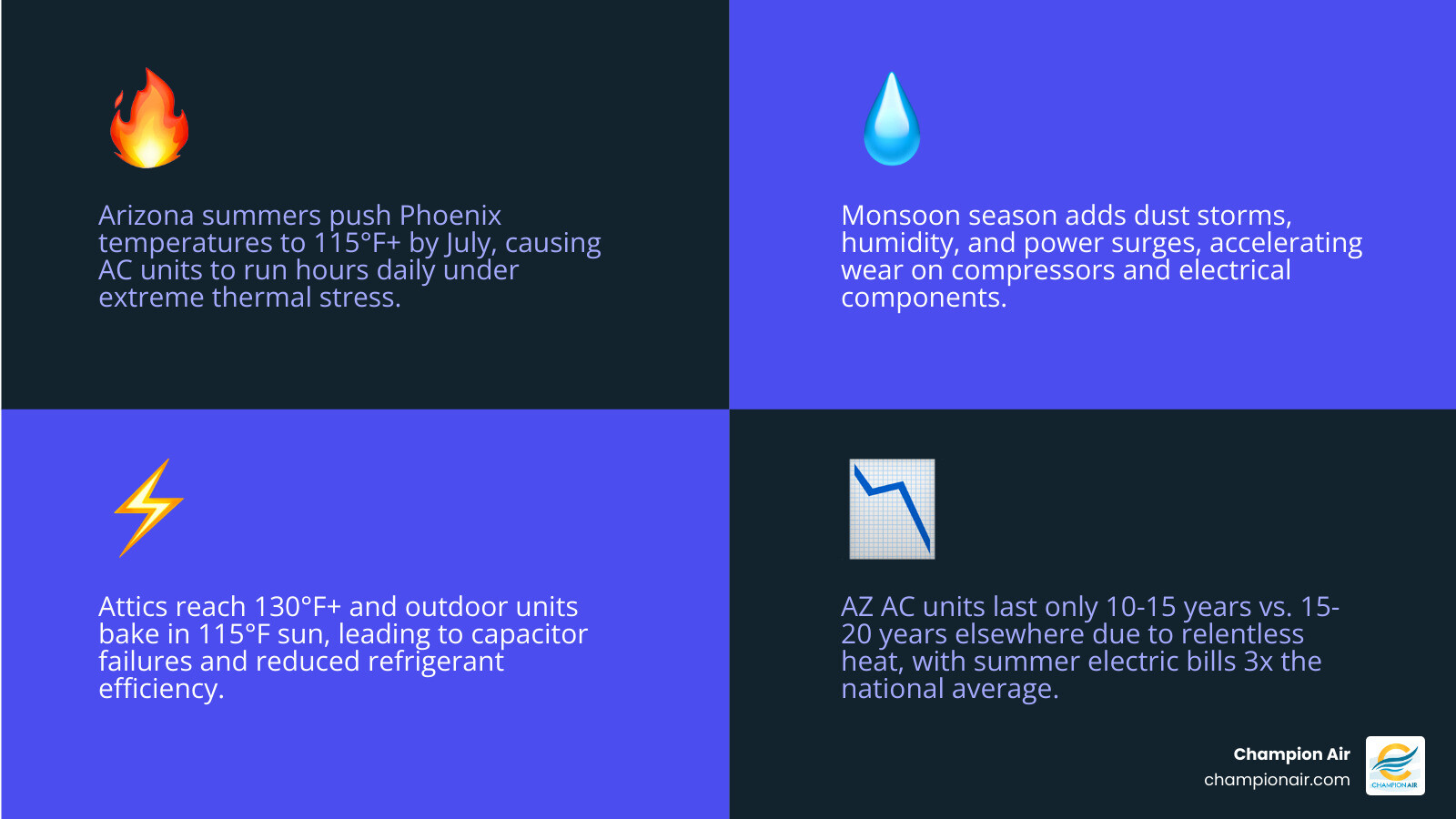
Arizona summers do not ease you in gently. By May, temperatures in the Phoenix metro are already pushing triple digits — and by July, your AC is running for hours at a stretch just to keep your home livable. The problem is that most systems were not built to handle this kind of punishment day after day, month after month. An AC unit in Phoenix works harder in a single July than many systems in milder climates work in an entire year. That relentless thermal stress is exactly why Arizona AC units typically last only 10 to 15 years, compared to 15 to 20 years in cooler parts of the country.
And it is not just the heat. Arizona's monsoon season layers humidity, dust storms, and power surges on top of already strained equipment — turning a minor maintenance gap into a full system failure at the worst possible time. When your AC goes down in the middle of a 115°F day, you are not just uncomfortable. You are in a situation that can become dangerous fast, with technician wait times stretching 24 to 48 hours during peak season.
The good news? Most breakdowns are preventable. For more on just how extreme Phoenix summers get, see our guide on How Hot Does Phoenix Get in the Summer.
I'm Barry Farah, and leading one of Arizona's largest residential HVAC replacement companies has given me a front-row seat to every way an Arizona summer can push a cooling system past its limits — which is exactly why I put together this guide on how to make sure your AC survives an Arizona summer. Let's walk through everything you need to do, starting with the maintenance steps that make the biggest difference.
Essential Maintenance: How to Make Sure Your AC Survives an Arizona Summer
When we talk about how to make sure your AC survives an Arizona summer, we aren't just talking about keeping it running; we’re talking about keeping it efficient. In a climate where the average household pays $100 extra per month during the summer for electricity—nearly three times the national average—efficiency is everything.
The mechanical stress of a desert summer physically changes how metal, oil, and electricity behave inside your unit. A capacitor that works perfectly fine at 80°F might fail instantly when your attic hits 130°F or your outdoor unit is baking in 115°F sun. By following 9 Tips for Extending the Lifespan of Your Air Conditioner, you can help your system reach that 12-to-15-year mark rather than facing an early retirement. To understand the timeline better, check out our insights on How Long Do Air Conditioners Last in Arizona.
Professional Inspections: How to Make Sure Your AC Survives an Arizona Summer
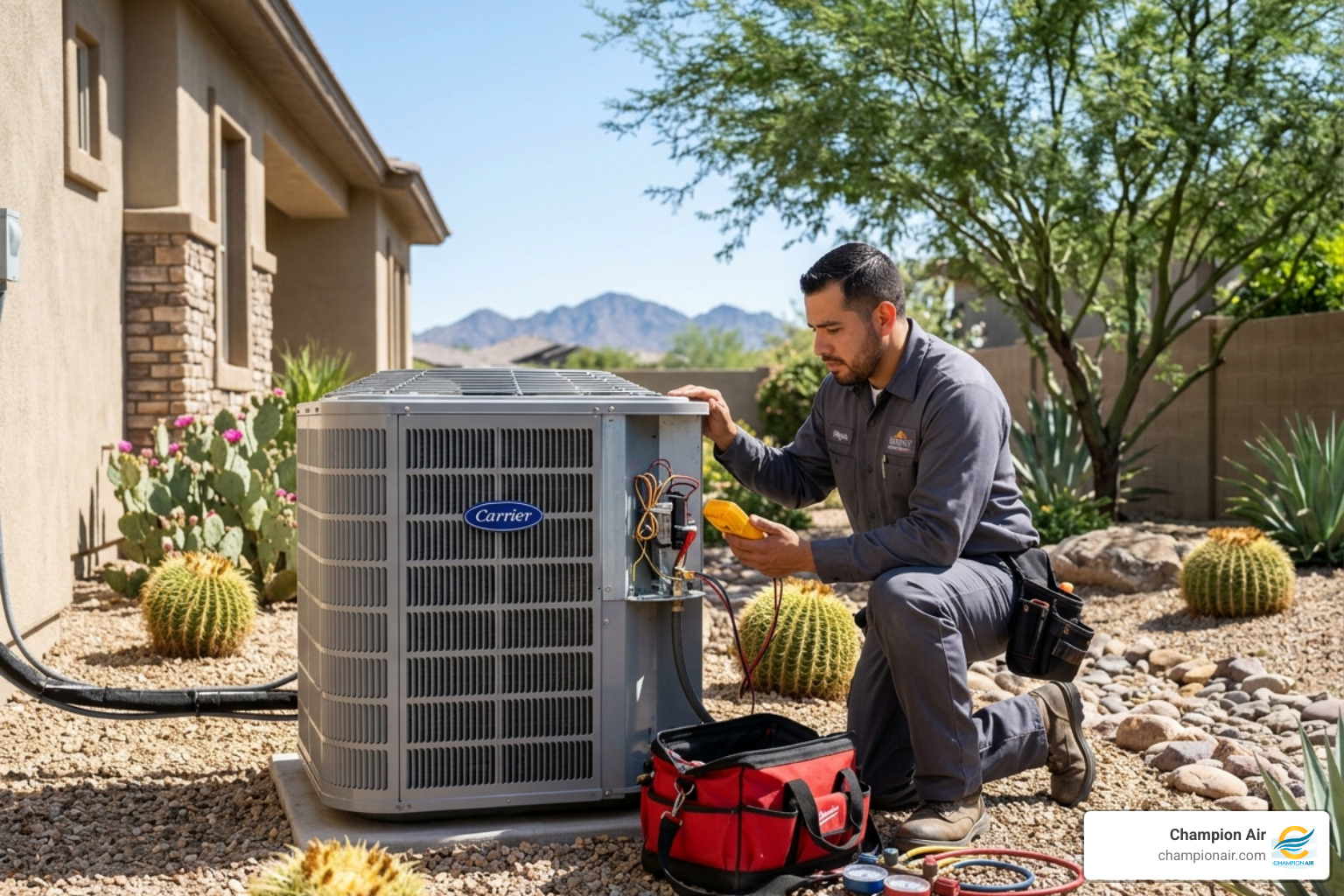
Think of a professional inspection as an "oil change" for your home’s most important machine. There are several Reasons Schedule Spring AC Tune-Up early in the year, but the most important is catching small issues before they become "no-cool" emergencies in July.
A Seasonal HVAC Tune-Up from our team covers the critical points that the average homeowner can't see:
- Refrigerant Levels: Even a small leak can force your compressor to work twice as hard, leading to a premature burnout.
- Capacitor Health: These are like the "batteries" that start your motors. Heat kills them, and a failing capacitor is one of the most common causes of summer breakdowns.
- Electrical Connections: Extreme heat can cause wires to expand and contract, loosening connections that can spark or fail.
To take the guesswork out of scheduling, many of our neighbors in Scottsdale and Mesa choose our Maintenance Plans, which ensure your system gets the professional eyes it needs twice a year.
DIY Habits: How to Make Sure Your AC Survives an Arizona Summer
While we handle the technical side, your daily and monthly habits are the "boots on the ground" for system survival. The single most important thing you can do is understand Why Changing Air Filters Is So Important.
In Arizona, the standard "every three months" rule does not apply. Between the fine desert silt, pet dander, and the fact that your AC runs almost 24/7, you should be checking and likely changing your filter every 30 to 45 days. A clogged filter restricts airflow, which is the fastest way to freeze up your indoor coil and kill your blower motor.
Additionally, learning How to Clean Your Air Conditioner can save you a world of trouble. Arizona dust acts as an insulator on your outdoor coils, trapping heat inside the system. A gentle rinse with a garden hose (spraying from the inside out) can remove that layer of silt and let your system breathe again.
Optimizing Your Home Envelope for Desert Heat
Your AC doesn't live in a vacuum. If your home is a "sieve" that lets heat in, your AC will never stop running. In Arizona, we treat our homes like a bunker against the sun. One of the most effective ways to do this is through attic insulation. The EPA notes that proper insulation can decrease energy consumption by up to 40%. In the Valley, we recommend an insulation level between R-38 and R-60. This prevents the 150°F heat in your attic from radiating through your ceiling and into your living space.
Windows and Shading Strategies
Windows are the largest source of heat gain in a desert home. Installing solar screens on the exterior of your windows can block 60% to 90% of the sun’s heat before it even touches the glass, potentially reducing your cooling costs by 25%.
| Treatment Type | Heat Block Percentage | Estimated Energy Savings |
|---|---|---|
| Standard Windows | 0% | 0% |
| Reflective Window Film | 40-70% | 10-15% |
| Solar Screens | 60-90% | 15-25% |
| Medium-Colored Curtains | 30-50% | 5-10% |
When choosing window treatments, go for medium-colored curtains with white plastic backings. Light colors let too much light through, while dark colors absorb heat and radiate it back into the room. Strategically planting desert-adapted trees like the Palo Verde or Native Mesquite on the south and west sides of your home can also provide natural shade that lowers the thermal load on your walls.
Ductwork Integrity and Insulation
Have you ever wondered How Long Should My AC Run in Arizona? If your ducts are leaking, the answer is "too long." Uninsulated or leaky ducts running through a 150-degree attic can lose 20% to 30% of their cooling capacity before the air ever reaches your vents. Essentially, you are paying to cool your attic. Using mastic sealing or foil tape to close these gaps—often identified through a professional blower door test—ensures the cold air you pay for actually stays in your home.
Strategic Cooling Habits and Smart Technology
Modern technology is your best ally in the fight against high utility bills. Prepping Your HVAC System for Summer includes more than just mechanical checks; it involves setting a strategy for your thermostat.
Supercooling and Time-of-Use Plans
One of the most effective "pro-level" strategies in Arizona is supercooling. If you are on a Time-of-Use plan with APS or SRP, your electricity might cost 20 cents per kilowatt during the day but only 6 cents at night.
Supercooling involves turning your home into an "ice chest" by running your AC at a very low temperature (like 68-70°F) during off-peak hours (overnight and early morning). When the expensive peak hours hit in the afternoon, you bump the thermostat up to 78°F or higher. Your home’s structure—the walls, floors, and furniture—acts as a thermal battery, staying cool for hours and preventing the AC from needing to kick on during the most expensive part of the day. This can save homeowners approximately 75% on energy costs related to cooling.
Smart Thermostats and Ceiling Fans
Smart thermostats take this a step further with GPS tracking. They can detect when you've left the house and automatically raise the temperature to 82-85°F, then begin a gradual cooling process so the house is comfortable by the time you walk through the door.
Don't forget the power of the wind-chill effect. Running ceiling fans counter-clockwise allows you to raise your thermostat by about 4 degrees without any loss in comfort. Just remember: fans cool people, not rooms. Turn them off when you leave the room to save even more. Understanding Why HVAC Maintenance Agreements Are Important often includes learning these efficiency tricks from our experienced technicians.
Preparing for the Arizona Monsoon Season
Monsoon season (June through September) brings a unique set of challenges. It’s not just the heat; it’s the "latent heat" or humidity. When the humidity spikes, your AC has to work twice as hard to remove moisture from the air before it can effectively lower the temperature. This is why many Valley homeowners consider a whole-home dehumidifier. By managing moisture levels with a humidistat, you can feel comfortable at 78°F even when it's muggy outside.
Outdoor Unit Protection and Clearance
You must also know How to Protect HVAC in Dust Storm. Dust storms, or haboobs, can coat your outdoor unit in a thick layer of silt. Ensure you have at least 2 feet of clearance around your condenser. Remove any weeds, boxes, or debris that could block airflow. After a major storm, give your unit a quick visual check. If the fins are matted with dirt, use a garden hose for a gentle "inside-out" spray to clear the debris.
Crucially, monsoons bring lightning. A whole-home surge protector can save your AC's expensive control board from being fried during a sudden power spike.
Warning Signs of Imminent Failure
Don't ignore the early warning signs. If you hear squealing belts, rattling parts, or notice ice formation on the copper lines, your system is crying for help. Other red flags include:
- Flickering thermostat screens
- Room-temperature air coming from vents
- The system "short-cycling" (turning on and off every few minutes)
Knowing How Often Schedule Maintenance is key to catching these signs before they turn into a full-blown failure.
Frequently Asked Questions about Arizona AC Survival
What is the ideal thermostat setting for an Arizona summer?
For the best balance of comfort and cost, we recommend 78°F when you are home. When you are away, bump it up to 82-85°F. Every degree you set the thermostat below 78°F increases your cooling costs by about 3% to 5%. Avoid turning the system off entirely during the day, as it will struggle for hours to "recover" and cool down the mass of your home once you return.
How often should I change my AC filter during peak heat?
In the Phoenix, Scottsdale, and Mesa areas, you should check your filter every month and replace it every 30 to 45 days. If you have pets, live near a construction site, or have a high-efficiency MERV-rated filter that catches smaller particles, you may even need to change it every 3 weeks during the height of July.
Should I cover my AC unit during the winter or monsoon season?
No. We generally advise against covering your AC unit in the winter. Covers can trap moisture, leading to rust and corrosion, and they provide a perfect nesting spot for rodents who might chew on your wiring. During monsoon season, the unit needs to be uncovered to breathe. Instead of a cover, focus on maintaining a 2-foot clear zone around the unit and performing post-storm inspections.
Conclusion
Surviving an Arizona summer is a marathon, not a sprint. By combining professional Maintenance with smart daily habits, you can protect your investment and keep your family comfortable through the record-breaking heat. Whether you are in Anthem, Buckeye, Chandler, or Surprise, our team is here to help.
At Champion Air, we are proud to serve the entire Phoenix metro area, from Scottsdale to Peoria and Mesa to Goodyear. We offer 24/7 emergency repairs with no overtime charges, because we know that AC failures don't always happen during business hours. Our licensed technicians have the local expertise to handle the unique demands of the Arizona climate.
About the Author
Champion Air
More Articles
View All PostsKeep Reading
Related Articles


Ready to Get Started?
Whether you need a repair, maintenance, or a new installation, our expert team is here to help.