A Tale of Two Units: How Your Indoor and Outdoor AC Work Together
Champion Air
Discover how the compressor evaporator and condenser function together for efficient AC cooling in Arizona homes. Learn maintenance tips now!
A Tale of Two Units: How Your Indoor and Outdoor AC Work Together
How the Compressor, Evaporator, and Condenser Function in Your AC System
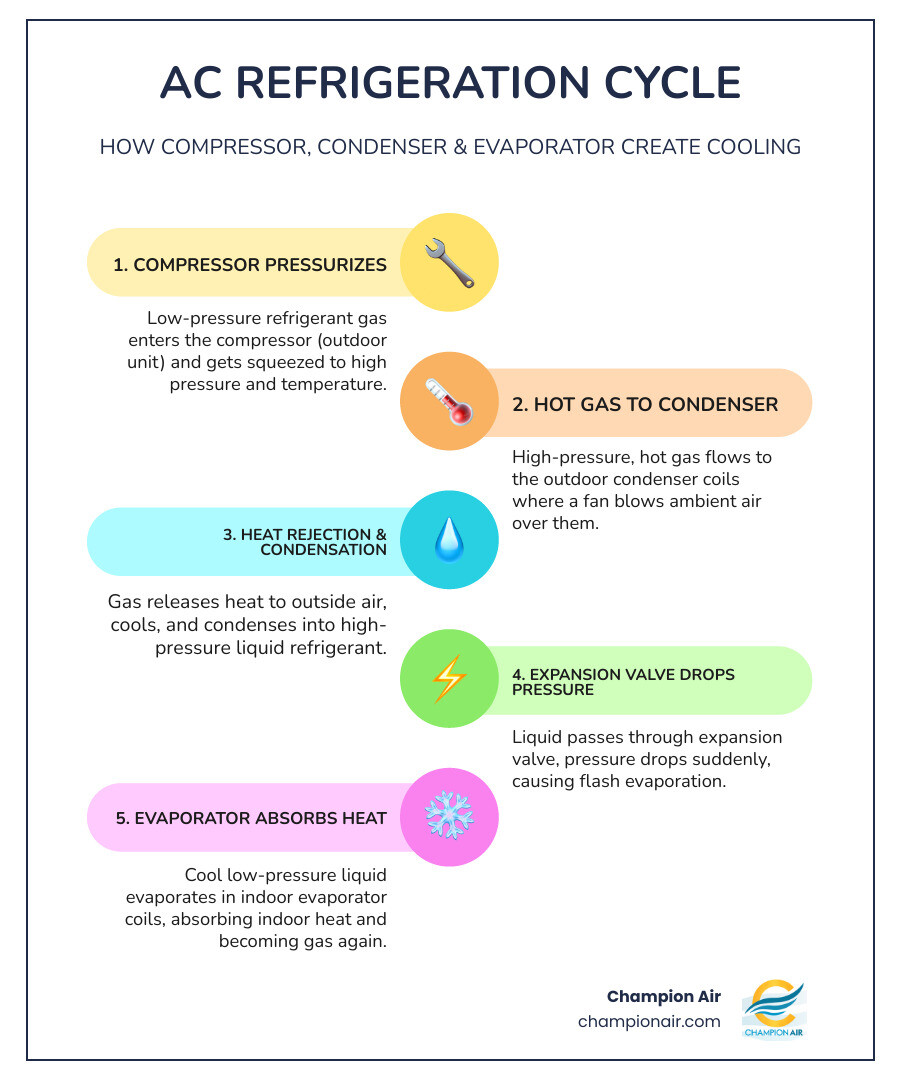
How the compressor evaporator and condenser function is one of the most important things to understand about your home's air conditioning system — and it comes down to three jobs working in a continuous loop:
| Component | Location | Primary Job | What Happens to Refrigerant |
|---|---|---|---|
| Compressor | Outdoor unit | Pressurizes refrigerant gas | Enters as low-pressure gas; leaves as high-pressure, high-temperature gas |
| Condenser | Outdoor unit | Releases heat outside | Changes from hot gas to liquid |
| Evaporator | Indoor unit | Absorbs heat from inside your home | Changes from liquid to gas |
Together, these three components move heat from inside your home to the outside — over and over again, every time your AC runs.
Most homeowners in Arizona don't think much about what's happening inside their AC unit — until something goes wrong on a 110°F summer afternoon. The reality is that your system isn't "making cold air." It's pulling heat out of your home and dumping it outside, using a refrigerant that cycles through carefully controlled changes in pressure and state. Understanding how this works helps you spot problems early, maintain your system better, and make smarter decisions when something breaks.
I'm Barry Farah, and as the leader of one of Arizona's top residential HVAC companies, I've spent years helping homeowners understand how the compressor evaporator and condenser function so they can protect their comfort and their investment. In the sections ahead, I'll break down each component clearly — no engineering degree required.
The Heart of the System: The Compressor’s Role
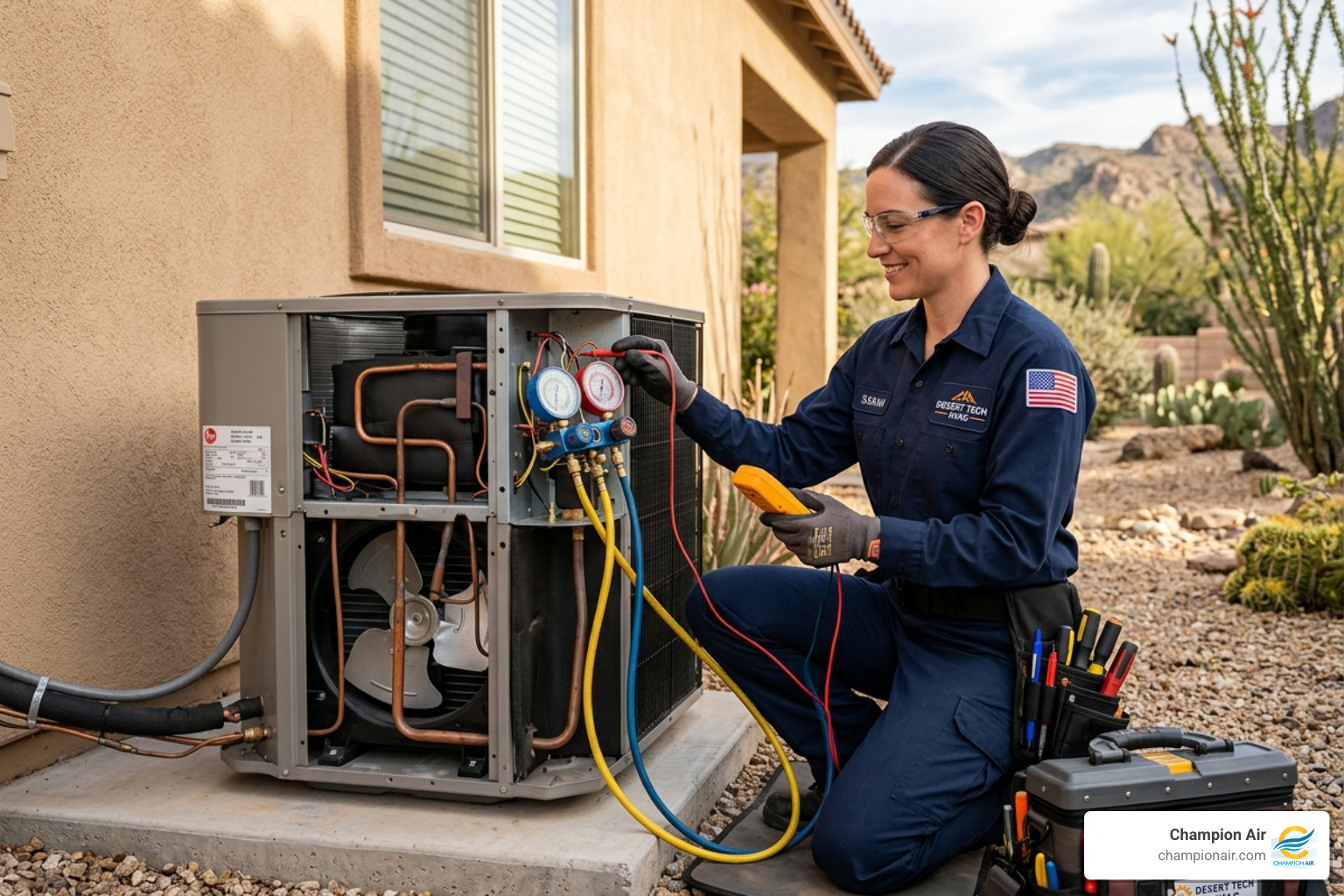
If the refrigeration cycle had a "boss," it would be the compressor. Often referred to as the "heart" of your air conditioner, the compressor is the pump that keeps everything moving. Without it, the refrigerant would just sit still in the copper lines, and your home would stay exactly as hot as the Arizona sun dictates.
Think of the compressor as a "molecular packer." Its primary role is to take low-pressure, cool refrigerant gas returning from your indoor unit and squeeze it. When you pack gas molecules tightly together, two things happen: the pressure skyrockets, and the temperature rises significantly. By the time the refrigerant leaves the compressor, it is a high-pressure, high-temperature superheated gas.
In Scottsdale and Phoenix, we typically see three main mechanical types of compressors:
- Reciprocating: These use a piston-and-cylinder setup, much like a car engine, to compress the gas.
- Scroll: Common in modern residential units, these use two interlocking spiral-shaped scrolls to squeeze the refrigerant. They are generally quieter and more efficient.
- Centrifugal: Usually reserved for very large commercial buildings or industrial cooling, these use high-speed impellers to move the gas.
Because this component does the "heavy lifting," it is often the most expensive part to fix. If yours is struggling, you might want to look into AC Compressor Replacement Cost to see whether a repair or a full system upgrade makes more sense for your home.
Heat Rejection: The Condenser’s Function
Once the compressor has turned the refrigerant into a hot, high-pressure gas, it sends it to the condenser. Located in your outdoor unit, the condenser's job is to facilitate the transfer of heat from the refrigerant to the outside air.
This is where physics gets interesting. Even if it is 115°F in Phoenix, the refrigerant gas coming out of the compressor is even hotter. Because heat naturally moves from a warmer area to a cooler one, the outdoor air acts as a "sponge" for the heat inside the condenser coils. As a large fan blows outdoor air over these coils, the refrigerant loses heat and undergoes a physical change of state. It transitions from a hot gas into a high-pressure liquid.
This process is called condensation. Before the refrigerant leaves the condenser, it often undergoes "subcooling." This means the liquid is cooled several degrees below its boiling point to ensure that it is 100% liquid before it moves to the next stage. If you've ever wondered why the air blowing out of the top of your outdoor unit feels like a furnace, it's because that unit is literally dumping the heat it gathered from inside your living room. You can learn more about this outdoor workhorse in our guide: What Does an AC Condenser Do?.
The Science of Cooling: How the Compressor Evaporator and Condenser Function
To truly grasp how the compressor evaporator and condenser function, we have to look at the relationship between pressure and temperature. This is the "magic" that allows us to have 72°F bedrooms in the middle of a desert summer.
The boiling point of any liquid depends on the pressure it is under. For example, water boils at 100°C (212°F) at sea level. However, at the top of Mount Everest, where the atmospheric pressure is only about 0.34 bar (compared to 1 bar at sea level), water boils at just 71°C (160°F).
Air conditioners use special chemical refrigerants, like R-410A, which have incredibly low boiling points. At standard pressure, R-410A boils at approximately -55°F (-48.5°C). By manipulating the pressure inside your AC system, we can force the refrigerant to boil and evaporate at very low temperatures, allowing it to soak up heat from your home's air.
Between the condenser and the evaporator sits the expansion valve. This device acts like a dam, restricting the flow of the high-pressure liquid refrigerant. As the refrigerant passes through the valve into a low-pressure area, it undergoes "adiabatic flash evaporation." This is a fancy way of saying a portion of the liquid instantly flashes into vapor, causing the temperature of the remaining mixture to plummet.
Comparison of Critical States
| Process | Term | Definition | Purpose |
|---|---|---|---|
| In the Evaporator | Superheating | Heating gas above its boiling point | Ensures no liquid enters the compressor |
| In the Condenser | Subcooling | Cooling liquid below its boiling point | Ensures a solid column of liquid for the expansion valve |
Indoor Heat Absorption: How the Compressor Evaporator and Condenser Function in Your Home
The evaporator coil is the "business end" of the system. Located inside your home (usually in the attic or a closet), it is where the actual cooling happens. The cold, low-pressure refrigerant enters the evaporator coils. As your indoor fan blows warm house air across these chilled fins, the refrigerant absorbs the heat.
Because the refrigerant is so cold, the heat from your home causes it to boil, changing it from a liquid-vapor mix into a pure gas. This phase change is incredibly efficient at moving energy. During this stage, we aim for "superheating"—adding just enough extra heat to the gas to ensure that every single drop of liquid has evaporated before the refrigerant heads back to the compressor. If you are looking for the latest in coil technology, the Lennox Quantum Coil Benefits include superior corrosion resistance, which is vital for the longevity of your indoor unit.
Outdoor Heat Rejection: How the Compressor Evaporator and Condenser Function in the Desert
In our arid climate, the condenser has to work extra hard. The state change from gas to liquid releases what is known as "latent heat." Even when it's a dry heat in Mesa or Gilbert, your condenser must effectively shed this energy. This is why we always emphasize keeping the area around your outdoor unit clear of plants, debris, or "privacy fences" that restrict airflow. If the fan can’t blow enough air over those coils, the heat rejection process stalls, and your system will struggle to keep the house cool.
Frequently Asked Questions about AC Components
Why is it critical that the refrigerant enters the compressor as a gas rather than a liquid?
This is one of the most important rules in HVAC. Liquids are not compressible. If liquid refrigerant enters the compressor—a phenomenon known as "liquid slugging"—it can cause immediate and catastrophic mechanical failure. It’s like trying to compress a rock inside a piston; something is going to break. This is why the "superheat" buffer in the evaporator is so critical. If your system is leaking or the coils are dirty, it can lead to liquid reaching the compressor. If you notice your system isn't performing right, check out our guide on Why Is My AC Not Cooling?.
How does the relationship between pressure and boiling point allow the evaporator to function?
By creating a low-pressure environment in the evaporator, the AC system allows the refrigerant to boil at temperatures as low as -40°C. Because your home's air is much warmer than that (even if you keep it at 70°F), the refrigerant "sees" your house air as a massive heat source. It greedily absorbs that heat to fuel its vaporization process, leaving the air behind it much cooler and drier.
What is the difference between 'superheating' in the evaporator and 'subcooling' in the condenser?
Both are safety and efficiency margins. Superheating happens at the end of the evaporator to ensure the refrigerant is 100% gas before hitting the compressor. Subcooling happens at the end of the condenser to ensure the refrigerant is 100% liquid before hitting the expansion valve. Proper levels of both indicate a system that is charged correctly and operating at peak efficiency.
Conclusion: Maintaining Your Home Comfort in Arizona
Understanding how the compressor evaporator and condenser function is the first step toward lower utility bills and a longer-lasting AC system. In the extreme heat of May 2026 and beyond, these components are under immense stress. Simple steps like adjusting your thermostat 7-10 degrees higher when you aren't home can be more cost-effective than turning the unit off entirely, as it prevents the system from having to "catch up" during the hottest part of the day.
At Champion Air, we've seen how the dusty, hot environment of Scottsdale, Phoenix, and Mesa can take a toll on these delicate cycles. Whether it's a centrifugal compressor in a large estate or a scroll compressor in a suburban home, regular maintenance is the only way to ensure the heat transfer loop stays continuous and efficient.
If you hear strange noises, notice ice on your indoor coils, or feel like your vents are blowing lukewarm air, don't wait for a total breakdown. You can learn How to Troubleshoot Your HVAC System for Optimal Performance on our blog, or better yet, let our award-winning team handle the technical stuff.
Ready to ensure your home stays a sanctuary this summer? Schedule your expert air conditioning service today with Champion Air. We provide 24/7 emergency repairs with no overtime charges and same-day service across the Valley, from Anthem and Peoria to Chandler and Queen Creek. Let us keep your heart—and your compressor—beating strong.
About the Author
Champion Air
More Articles
View All PostsKeep Reading
Related Articles


Ready to Get Started?
Whether you need a repair, maintenance, or a new installation, our expert team is here to help.