Breathe Easy with the Best Air Filters for Arizona
Champion Air
Discover the best air filter for Arizona desert homes. Combat haboobs, dust & poor air quality with expert MERV 8-11 tips!
Breathe Easy with the Best Air Filters for Arizona
Why is the dust in Phoenix so hard on my HVAC system?
The best air filter for Arizona desert homes is a pleated filter with a MERV 8-11 rating. Here's a quick breakdown to help you choose:
| Filter Type | MERV Rating | Best For | Arizona Verdict |
|---|---|---|---|
| Fiberglass | 2-4 | Large debris only | Not recommended |
| Pleated (1-inch) | 8-11 | Dust, pollen, dander | Top pick for most homes |
| High-efficiency pleated | 11-13 | Allergies, fine dust | Good if system supports it |
| HEPA / MERV 13+ | 14-16 | Ultra-fine particles | Requires professional assessment |
Living in the Valley of the Sun means your HVAC system fights a constant battle. Arizona's desert air carries fine Sonoran dust, seasonal pollen, and the occasional haboob that can push airborne particle levels to more than 30 times the EPA's safe daily threshold. That's not a standard air quality problem — it's an extreme one. And the filter sitting in your HVAC system is the first and most important line of defense between that outdoor air and the air your family breathes inside.
The challenge is that most homeowners either use filters that are too weak to catch fine desert dust, or they upgrade to filters so restrictive that they strain the very system they're trying to protect. Getting that balance right is what this guide is all about.
I'm Barry Farah, and as the leader of one of Arizona's largest Lennox family-owned residential HVAC replacement companies, I've spent years helping Phoenix, Scottsdale, and Mesa homeowners find the best air filter for Arizona desert homes that keeps both their families healthy and their systems running efficiently. Read on for everything you need to make a confident, informed choice.
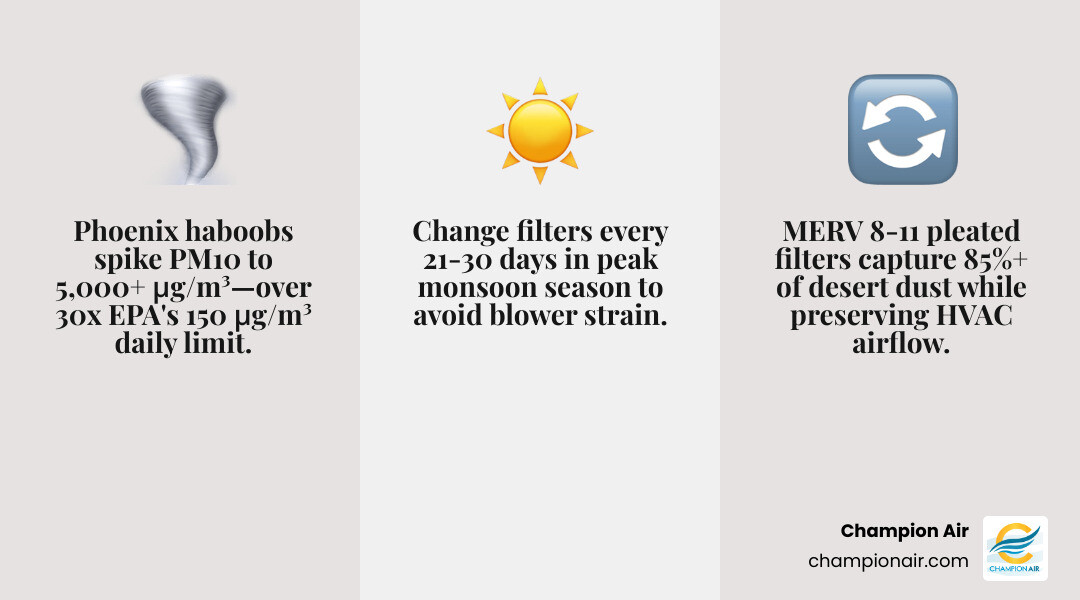
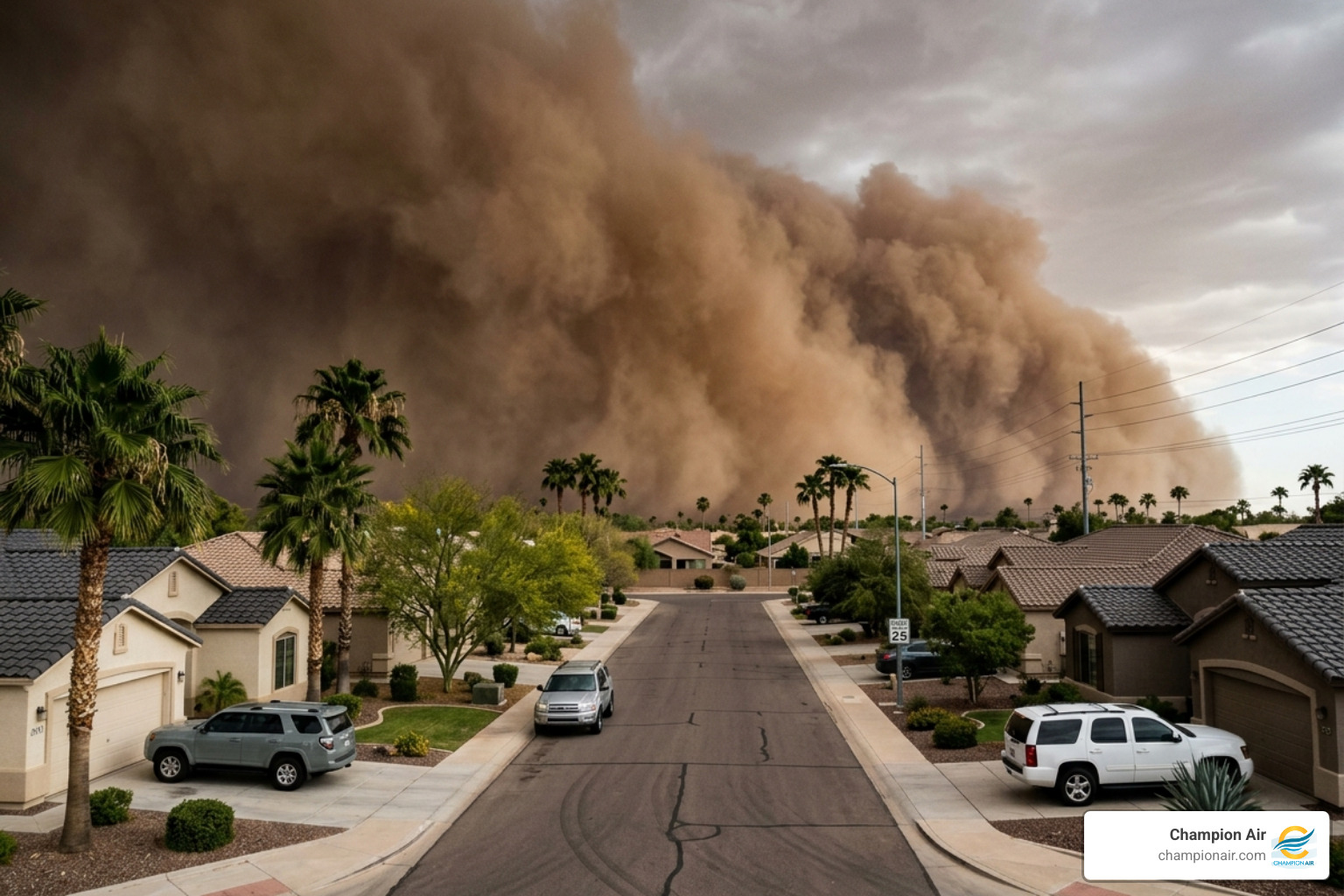
If you’ve lived through a summer in the Valley, you know that a "dust storm" isn't just a bit of wind. During a Phoenix haboob, PM10 (particulate matter) concentrations can skyrocket, often exceeding 5,000 μg/m³. To put that in perspective, the EPA’s daily safety threshold is just 150 μg/m³. This isn't just "dirt"; it's a cocktail of fine silica, organic matter, and construction debris that acts like sandpaper on your HVAC components.
Beyond the big storms, we deal with winter temperature inversions from November to February. During these months, stagnant air traps pollutants near the ground, causing PM2.5 levels—the tiny particles that can penetrate deep into your lungs—to spike 4 to 8 times higher than baseline levels.
When your AC or furnace pulls in this air, it's not just the filter that takes a hit. If the filter is inadequate, that fine silt bypasses the media and settles on your evaporator coils and blower motor. This leads to a "dirty air in, dirty air out" cycle. Learning How to Protect HVAC in a Dust Storm is vital for anyone living in the Sonoran Desert, as this unique environment requires a much more aggressive filtration strategy than homes in more humid, less dusty climates.
Finding the Best Air Filter for Arizona Desert Homes
Choosing the right filter is a balancing act between filtration efficiency and airflow. In the HVAC world, we use the MERV (Minimum Efficiency Reporting Value) scale, which ranges from 1 to 16. The higher the number, the smaller the particles the filter can catch. However, a higher number also means more resistance to airflow.
Comparing Pleated vs. Fiberglass Filters
In Arizona, the choice between these two isn't even a contest.
| Feature | Fiberglass Filters | Pleated Filters |
|---|---|---|
| MERV Rating | 2–4 | 8–13 |
| Dust Capture | Only large debris (lint/hair) | Fine dust, pollen, dander |
| System Protection | Minimal | High |
| Lifespan | 30 days (max) | 30–90 days |
| Arizona Verdict | Fails to stop desert silt | The Gold Standard |
Fiberglass filters are often called "rock catchers." They are designed to protect the machine from large objects like pet hair or clumps of carpet fiber, but they do almost nothing for Air Quality. Fine desert dust passes right through them. This is Why Changing Air Filters Is So Important; using a cheap filter in Phoenix is like trying to catch sand with a chain-link fence.
Why MERV 8-11 is the Best Air Filter for Arizona Desert Homes
For the majority of homes in Scottsdale, Mesa, and Peoria, a MERV 8 to 11 pleated filter is the "sweet spot." These filters are constructed from polyester or cotton paper media folded into pleats, which increases the surface area for catching particles without drastically increasing the "static pressure" (the resistance the blower motor has to push against).
A MERV 11 filter can capture over 90% of large particles and a significant portion of the fine dust that plagues our region. It helps Boost Indoor Air Quality by trapping Palo Verde pollen and dust mite debris without causing the blower motor to overwork, which is a common cause of high energy bills and premature system failure in the 115°F heat.
Selecting the Best Air Filter for Arizona Desert Homes During Haboob Season
During the monsoon season, your filter needs are different. A single haboob can dump more dust into your system in one hour than it usually sees in three months. For this time of year, we recommend high-quality pleated filters made of synthetic materials. They are more rigid and less likely to collapse under the weight of heavy dust loads.
Understanding How Are Indoor Air Quality and HVAC Related? is key here: your HVAC system is the "respiratory system" of your home. If the filter is clogged with haboob silt, the system "suffocates," leading to frozen coils and potential compressor failure.
How often should I change my air filter in Scottsdale and Mesa?
In most parts of the country, the advice is to change your filter every three months. In Arizona, following that advice is a recipe for disaster. During peak AC months (May through September), we recommend checking your filter every 21 days and replacing it at least every 30 days.
Several factors in the Valley accelerate this timeline:
- Monsoon Season: Wind-blown dust fills filters rapidly.
- Evaporative Coolers: If you use a "swamp cooler," the added moisture can cause fiber filters to soften and clog faster.
- Pet Dander: In our dry climate, dander stays airborne longer and gets pulled into the return vents.
- Allergy Seasons: Spring and fall pollen spikes require fresh filters to keep symptoms at bay.
Following these 6 Tips to Improve Your Indoor Air Quality starts with a simple visual inspection. If you can’t see the filter material through the dust, it’s time for a change.
I'm concerned about air quality in my house; what advanced solutions work in the desert?
Sometimes, a standard filter isn't enough, especially for residents dealing with asthma or the threat of Valley Fever. Valley Fever is caused by fungal spores in our soil that become airborne during construction or dust storms. To combat this, we offer specialized Indoor Air Quality Services that go beyond the basic 1-inch filter.
- Air Scrubbers: Using ActivePure technology, these units are installed directly into your ductwork. They use UV light and a catalytic process to create "scrubbing molecules" that actively treat the air and surfaces in your home, reducing up to 99% of contaminants.
- UV Purifiers: These target biological growth on your HVAC coils, which is essential if you have any moisture issues or use an evaporative cooler.
- HEPA Bypass Systems: Since a standard HVAC blower usually can't handle a HEPA filter (which captures 99.97% of particles down to 0.3 microns), a bypass system pulls a portion of the air through a HEPA filter and returns it to the main stream, providing hospital-grade air without killing your blower motor.
- Electronic Air Cleaners: These use an electric charge to "magnetize" dust particles, causing them to stick to a collection plate. They are highly effective against the fine smoke and silt found in the Phoenix basin.
Frequently Asked Questions about Arizona Air Filtration
Can I use a HEPA filter in my standard Phoenix HVAC system?
Usually, no. Standard residential systems are designed for a certain amount of airflow. HEPA filters are so dense that they act like a "thick wool blanket" over your system. This creates high static pressure, which can lead to whistling sounds, frozen evaporator coils, and even a burnt-out blower motor. If you want HEPA-level cleaning, you need a professional to install a bypass system or a dedicated media box.
Do washable electrostatic filters work well in the desert?
They are tempting because they are reusable, but they come with risks. In Arizona, they must be cleaned monthly and—crucially—dried perfectly before being reinstalled. If they are even slightly damp, they can become a breeding ground for mold in your dark ductwork. Furthermore, their filtration efficiency for fine PM2.5 particles is often lower than high-quality disposable pleated filters.
How do I know if my air filter is too restrictive?
Listen to your home. If you hear a high-pitched whistling at the return vent, or if your system seems to be "short cycling" (turning on and off rapidly), your filter might be too thick. Another sign is a sudden spike in your energy bill or ice forming on the copper lines outside. These are signs that your system is struggling to breathe.
Conclusion
Finding the best air filter for Arizona desert homes is about more than just buying the most expensive option at the hardware store. It’s about understanding the unique challenges of the Sonoran Desert—from haboobs to fine silica dust—and matching your filtration to your specific HVAC system's capabilities.
At Champion Air, our licensed technicians have decades of experience serving Scottsdale, Phoenix, Mesa, and the surrounding Valley cities. We understand the local climate because we live here, too. Whether you need a simple maintenance check or a comprehensive indoor air quality overhaul, we're here to ensure you can breathe easy in your own home.
Don't let desert dust take a toll on your health or your wallet. Schedule your professional HVAC maintenance today and let us help you find the perfect filtration solution for your home.
About the Author
Champion Air
More Articles
View All PostsKeep Reading
Related Articles


Ready to Get Started?
Whether you need a repair, maintenance, or a new installation, our expert team is here to help.